AGM address 2003

Apr 25, 2003

Distinguished shareholders,

We are now into the third year of the weakening trend in the world economy and declining share prices on the stock markets. These have been exceptionally difficult times for most shareholders. Many commentators have compared the situation with the stock market crash in the early 1930s. And as spring advances, we can still see no clear sign of an upturn.

The trend for Swedish Match during this challenging period has been favorable for you as shareholders. The Group has been one of the most successful creators of value on Stockholmsbörsen (the Stockholm stock exchange). For the past four years, we have delivered rising profits and increased dividends, and the market has shown its appreciation in the form of a favorable share price trend. Through our redemption and buyback programs, approximately 66 percent of net profit has been returned to shareholders during the past four years. Those who have held their shares since the company returned to the stock market in 1996, when the share price was less than 20 SEK, have received an excellent return on their capital since then in the form of dividends and share redemption and buyback programs.
The background to these developments is a combination of industry-specific factors, the strategic initiatives we have taken in response to industry trends, and our shareholder-focused policies.

Swedish Match has an extremely strong platform in the tobacco industry - an industry whose development and future are often viewed in a negative light. We can confirm, however, that many tobacco companies with healthy market positions generally have strong fundamentals in the form of stable sales volumes, favorable earnings and a good cash flow.

The fact is that the tobacco companies have shown an unusually stable capacity over time to generate positive earnings from operations - a capacity that few other industries have been able to match over a long period of time.

For Swedish Match, the essence of this value creation is its ability, in the face of tough competition, to develop, produce and sell products that attract discriminating customers throughout the world. It is a question of building value into our brands to create long-term profitability. We must also be prepared to participate in the consolidation that is under way in the industry and is set to continue, mainly among cigarette producers, but also in our own product areas. Our experiences in the area of acquisitions over the past four years have been positive, and acquisitions have certainly contributed to Swedish Match's shareholder value.

However, these positive features cannot disguise the fact that the industry has structural problems. As a result of the growing concern and awareness regarding the health risks associated with smoking, the tobacco industry's dominant product by far - cigarettes - is faced with declining demand.

But it is precisely these changes in the conditions within the industry that Swedish Match has transformed into its main business opportunity. When we changed the emphasis of our strategy four years ago, we did so after carefully analyzing long-term patterns of consumption, particularly concerning the future of cigarette smoking.

The answers we obtained gave rise to our basic strategy of focusing on alternatives to cigarette smoking, of creating balanced and long-term growth in the tobacco area - of growing with social trends, not against them.

This brings me to the internal factors behind our results to date:

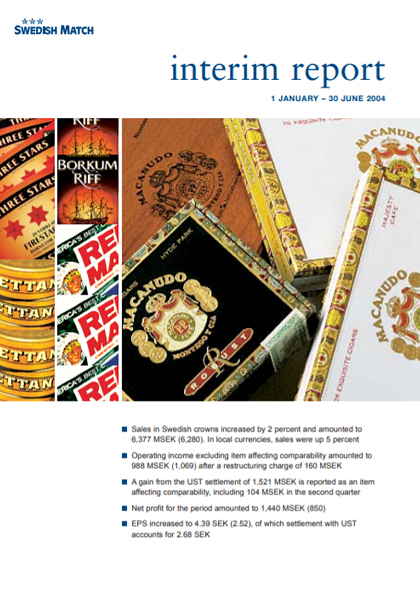
Following the divestment of our cigarette operations, our strategic agenda was based on the objective of rapidly building up a position as a leading global player in the area of niche tobacco products. Our aim was to become the leading global player in the Other-Tobacco-Products - or OTP - segment. We acquired a number of cigar companies in the US, with the result that we are today the world's second largest cigar producer. Cigars are a form of indulgence that is socially acceptable on special occasions.

With the same focus on profitable niches with substantial cash flows, we continued to target other niche tobacco products. We are number one in the US in chewing tobacco, and one of the world's largest producers of pipe tobacco. Through product and brand development, as well as acquisitions, we have continued to strengthen our leading positions.

We have also devoted considerable resources to our non-tobacco products - matches and lighters - in which we are number one and number three respectively worldwide. These are high-volume products in the retail sector in countries outside Europe and North America where we have to accept a somewhat higher level of risk due to more unstable currency conditions. But on the whole they can show healthy margins over time if we manage them correctly. They also contribute to the potential of the entire Group by providing an effective base for market expansion in areas that normally have a higher growth rate than the mature markets in the West. We have now structured and streamlined production and developed our products and marketing in such a manner that these two business areas have shown good profitability during the past year. As I indicated, they make a meaningful contribution to a logical whole for the company, particularly in the distribution and sales channels. We hold leading positions in matches and lighters and these products can support our global sales of tobacco products.

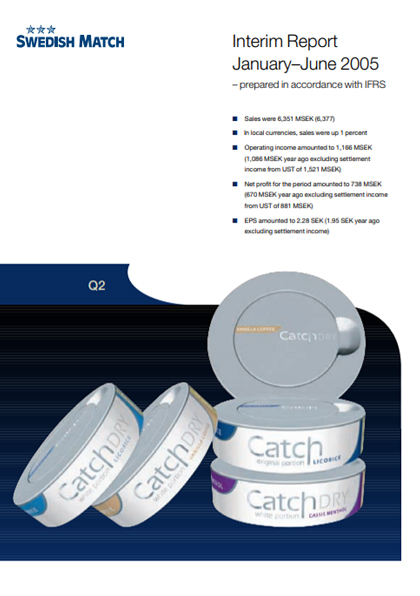
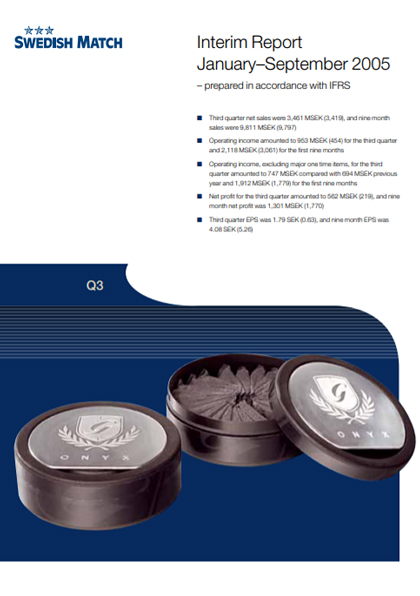
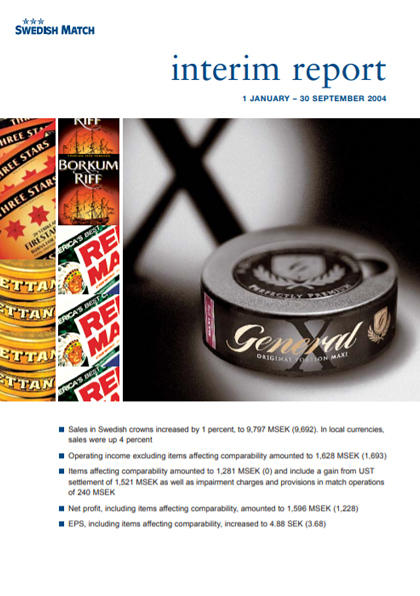
However, the focal point of our strategies is naturally snuff, the product which - more than any other - offers a realistic alternative for anyone who wants to quit smoking. Swedish Match has a century of experience in this area and has built on and deepened this know-how during the past 30 years through highly proficient research and product development. The result is our Swedish snus, which is protected by the GothiaTek quality designation.

Snus is our spearhead product for the future - a product that provides healthy margins and a strong cash flow, as well as showing considerable growth. Snus integrates our commercial interests with key social trends. We can offer an effective alternative to cigarette smoking.

We have made substantial investments in product development, production and marketing, aimed at further clarifying the role of snuff in this regard. We are working purposefully and systematically to gradually build up a global position. Our portion-packed snus has revolutionized snus consumption. A series of new products have been launched. Our snuff is sold in an increasing number of markets, and our market success has continued in the US, the world's largest market for snuff. The first trial cans have now been produced at our new plant in Kungälv in Sweden, an investment that represents a further step in our development of production technologies in line with the highest food standards.

These investments have helped to bring us an increasing degree of international recognition for the potential of snuff as an alternative to smoking. In relative terms, Sweden has a lower incidence of tobacco-related illnesses than comparable countries, and the number of smokers has declined more rapidly. Sweden is now the only western country to have achieved the World Health Organization's target of fewer than 20 percent smokers among a country's adult population. Around half of the approximately one million snus users in Sweden are former smokers, and a considerable number are women. In the international debate on tobacco, all of this data is summarized in the concept of "The Swedish Experience," which, as a result of research findings and opinion articles, has attracted attention both within and outside the industry, and in scientific magazines.

In addition to these operational strategies, we have also established financial strategies designed to ensure that Swedish Match does not work with more capital than is needed for the healthy development of operations and stable financial development. We have an explicit policy that "surplus funds" are to be returned to shareholders. In addition to relatively high dividends, shareholders have received cash through a redemption program and the increase in the value of their shares as a result of the buyback program.

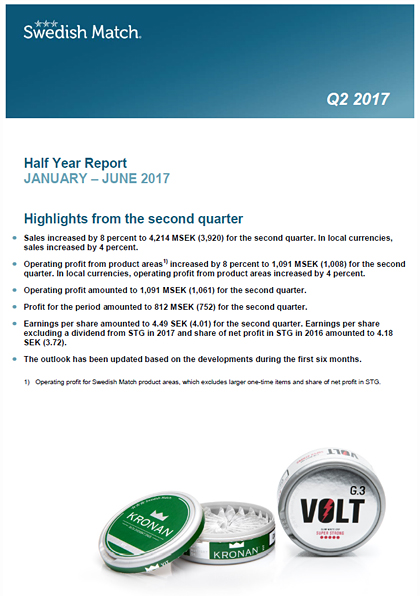
Our strategies and our development of operations once again gave us a favorable earnings outcome for 2002, about which you can read in more detail in the Annual Report. But permit me to comment on a few key points:

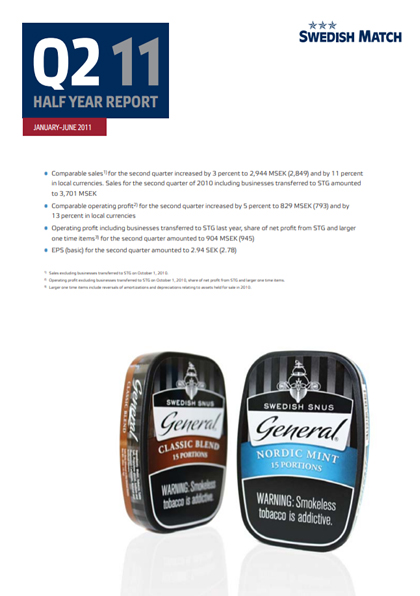
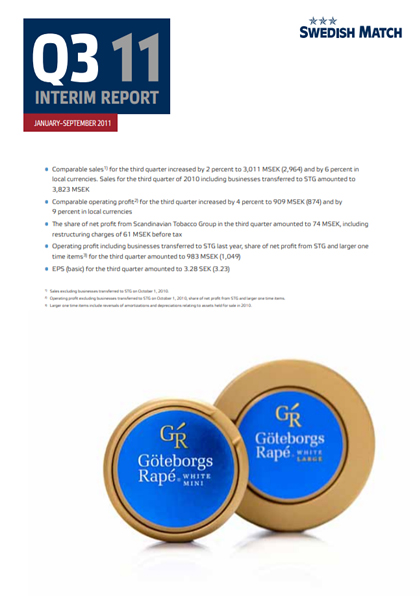
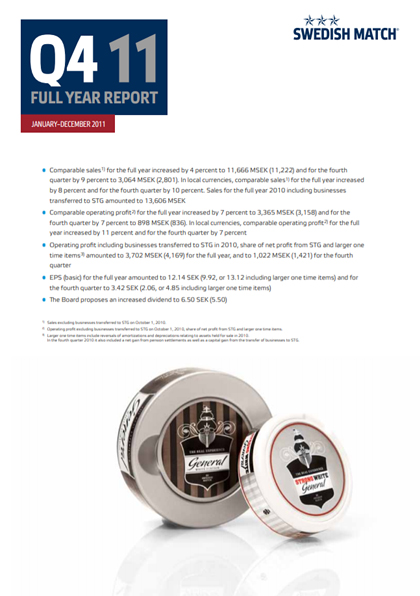
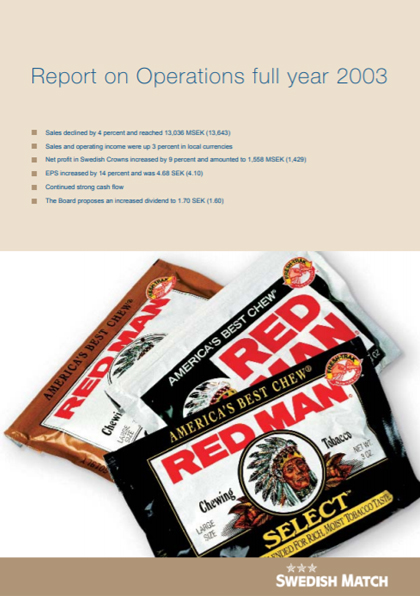
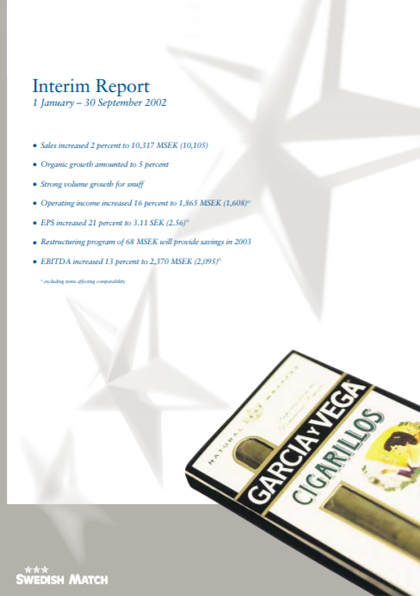
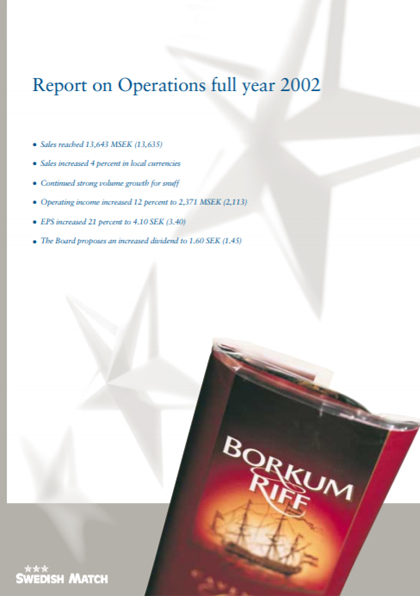
  • Sales of SEK 13.6 billion were essentially unchanged in SEK but increased by 4 percentage points in local currencies, which means that we had a negative exchange-rate effect amounting to 4 percentage points during last year.
  • On the other hand, operating income, excluding items affecting comparability, rose 12 percent to SEK 2.4 billion, and all product areas except pipe tobacco and lighters showed improved margins.
  • Earnings per share increased by 21 percent to SEK 4.10 as a result of improved earnings and the share buyback program.
  • Return on shareholders' equity amounted to 35 percent, compared with 28 percent in the preceding year.

Now I would like to comment on individual products and markets:

  • Snus continued to show favorable growth. Volume growth in terms of numbers of cans sold was 6 percent in the Nordic region and 10 percent in the US. Our market share in the US improved by 9 percent. Operating income and the operating margin improved considerably.
  • The trend in our other major area, cigars, was more subdued, with sales unchanged in local currencies. Operating income increased slightly, as did margins. Our restructuring program in the Continental Europe Division continued according to plan, and one of the two plants in Belgium was closed in December.
  • Among the other business areas, we can note a weaker trend in pipe tobacco, where we were affected by the substantial weakening of the South African rand (ZAR) and a weak year for the South African economy in general. The slight weakening of earnings for lighters was due to increased competition from low-cost countries. Matches, on the other hand, showed a favorable earnings trend and strong margins, despite virtually unchanged sales figures.

A prioritized initiative during the year was to reduce the Group's operating capital to improve cash flow from operations. We achieved good results with our various programs. Cash flow from operations strengthened by nearly SEK 1 billion to SEK 2.6 billion, with a considerable contribution from the reduction in working capital. We plan to continue with this type of capital rationalization, with the aim of increasing shareholder value. And now some brief comments on the first quarter of 2003:
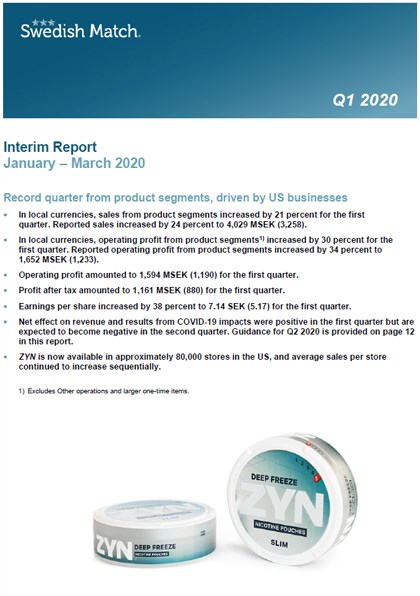
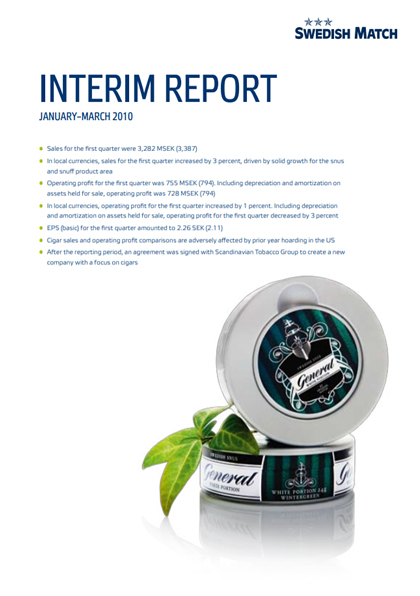
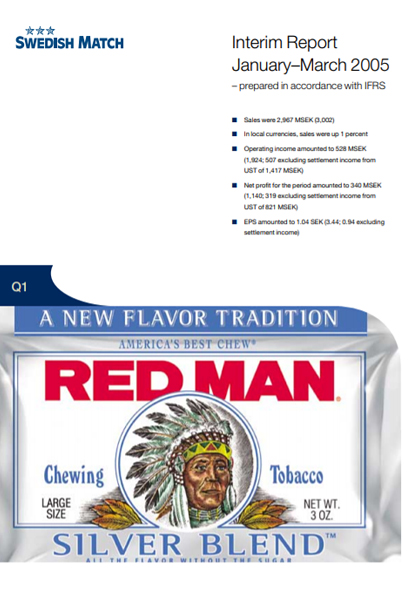
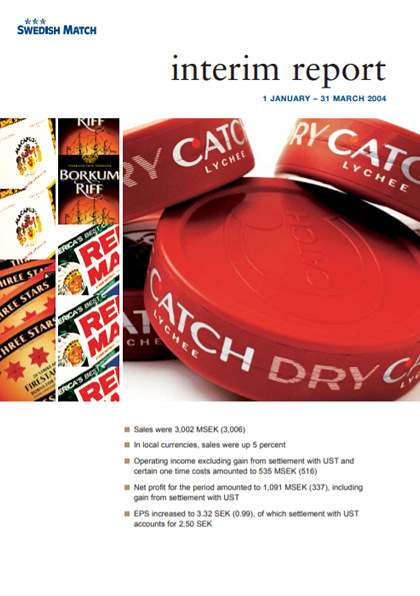
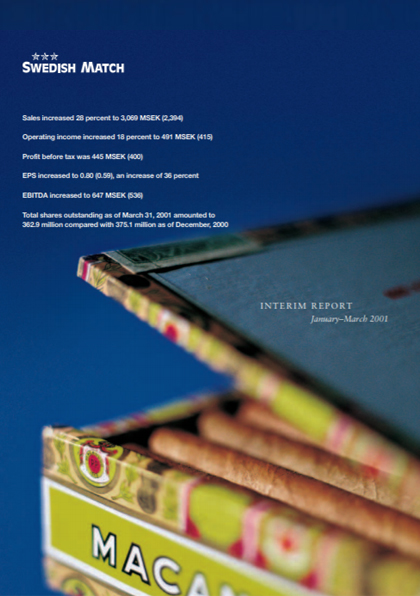
Snuff continues to perform well. Volume growth was 6 percent in the US and 3 percent in the Nordic region, which meant that sales increased by 3 percent to 689 MSEK and operating income by 5 percent to 305 MSEK. Margins remain high at 44.3 percent.

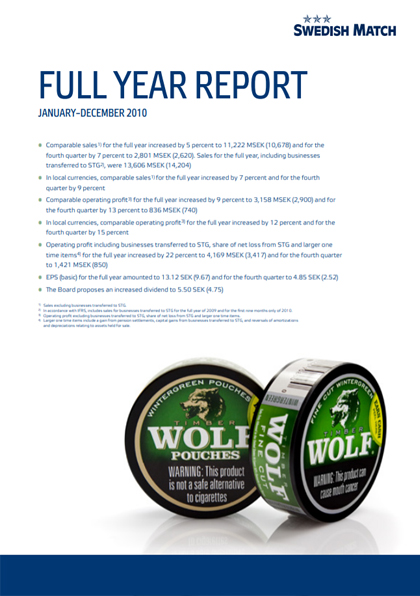
Our stable chewing tobacco operations continue to follow the same pattern: a slight increase in sales in local currencies, but a 14-percent decrease in SEK. Operating income was 84 MSEK and the operating margin was 28.5 percent.

Pipe tobacco, which was affected last year by the fall of the ZAR in South Africa, has recovered, thanks to a slightly stronger ZAR and improved volumes. Sales increased by 12 percent in SEK, and operating income was 46 MSEK. In this product area also, we have favorable margins of more than 21 percent.

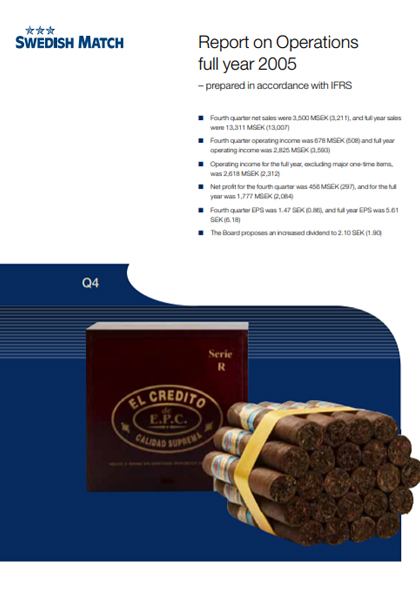
Cigar sales declined during the first quarter, influenced to some extent by the global mood of uncertainty during the past few months. Sales in the US declined by approximately 3 percent in USD but substantially more in SEK, due to the weaker dollar. Sales declined by more than 10 percent in Europe, where a relatively comprehensive restructuring program is under way that is also having an impact on figures, due to the costs for moving and for bringing operations onstream. We noted a certain hesitancy to place orders on the part of the retail sector in Europe. The product area reported sales of 644 MSEK, which was a decline of 17 percent in SEK. Operating income was 80 MSEK.

Sales within Match operations were affected by the sharp decline - by a full 44 percent - in the value of the Brazilian real (BRC). The country is a large market for our matches and changes affecting the currency have a heavy impact on the business area's earnings in SEK. The product area's margin was 11 percent, which is good for this type of operation. Lighters continued to encounter tough competition from low-cost countries. Both sales and operating income declined somewhat, to 151 MSEK and 9 MSEK respectively.

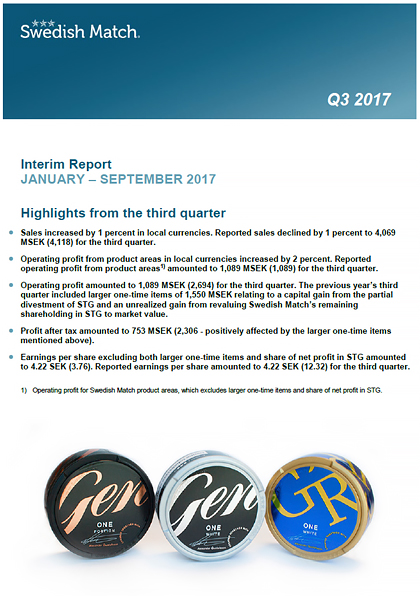
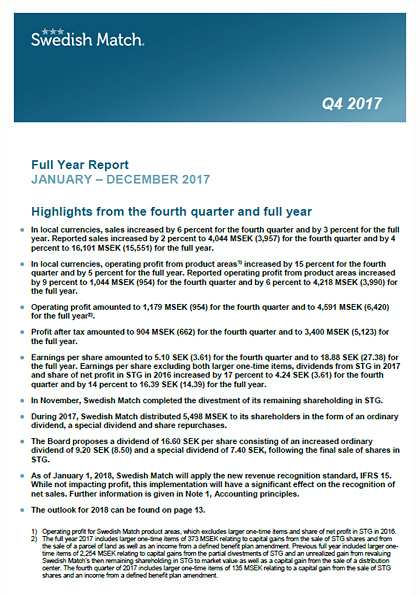
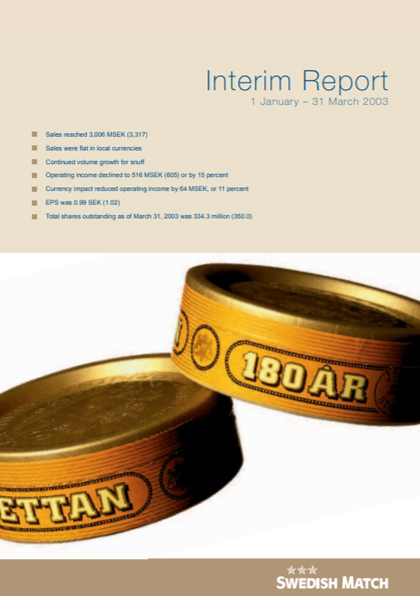
All of this together amounts to a 9-percent decline in Group sales in SEK - to 3,006 MSEK. In terms of local currencies, sales were unchanged. Operating income declined 15 percent to 516 MSEK. Exchange rates had an adverse impact amounting to 64 MSEK, compared with the corresponding quarter in 2002.

Earnings per share declined by 3 percent during the period, to SEK 0.99.

Swedish Match is in every respect a global company. We have production facilities in many parts of the world that supply the nearby regional and local markets with our products. We have substantial production in Sweden, the US, Continental Europe and major growth countries, such as India, Brazil and South Africa. This means that overall we have a relatively good risk spread. Our operating costs and revenues are largely concentrated in the currency areas that are most significant for us. We have relatively few revenue and cost flows passing between currency areas in the form of exports and imports.

Exchange-rate fluctuations appear in our figures without delay as translation gains or losses, when we are reporting on operations in SEK. When, for example, the US dollar, the South African rand and the Brazilian real decline in value against the SEK, we report less value in SEK in our consolidated financial statements. This is important to note when assessing the Group's long-term development. Exchange-rate changes benefited us considerably from 1999 until the beginning of 2001, since when we have been battling against an increasingly strong current in terms of exchange rates.

Against this background, developments over the past few years have given us a highly effective platform for continued profitable long-term growth. The health risks associated with smoking continue to be a focus of scientific research and public debate. We are seeing increased involvement on the part of officialdom in terms of physical restrictions on smoking, tougher taxation, more trenchant warning texts, information programs and campaigns. This is particularly apparent in the US, but is also increasing in Europe. We expect a similar trend to occur, after a certain delay, in other parts of the world. The outlook for snuff is virtually the opposite - warning texts are being toned down and we are encountering increased understanding for the proposition that snus is a realistic alternative for those who do not wish to continue smoking.

Last year we also reached an important milestone in our efforts to eliminate the unjust ban on sales of snus in the EU - a ban from which Sweden was granted a permanent exemption when it became an EU member state. A German court decided to refer the issue of the legality of snus to the European Court of Justice. Subsequently, the High Court in the UK also decided to refer the matter to the European Court.

The ban is unreasonable in many respects - particularly from the viewpoint of the many smokers who are seeking an effective alternative to help them quit smoking. The legal process in the European Court is expected to take about two years, and we are convinced that, one way or another, the ban will be lifted.

Accordingly, we will stick to our strategies and work intensively to make use of the business opportunities that social trends present to us. We will continue our efforts to become the world's leading company in niche tobacco products, focusing on smokeless tobacco alternatives but remaining open to other potential products. We will continue to develop our expertise and our products, with the emphasis on smokeless products. Rational production and effective capital management will constantly be on the agenda. Market expansion is a high priority, but will occur only after careful analysis. The same applies to acquisitions. We view the entire world as our field of operations.

As an example, I can cite the fact that our test sales of Swedish snus continued in India last year. Sales developed positively and were expanded to several other states in India.

Changes in traditional consumption patterns are a process that will take varying lengths of time in our different markets. Most countries in the world lack a snus culture of the Swedish type. In Sweden, the consumption peak for cigarette smoking was reached during the years around 1980. It took 20 years for cigarette smoking to halve and snus consumption to double.

But in a world that contains approximately one billion smokers, Swedish Match's smokeless products have a vital and constructive role to play in international, national and individual initiatives to reduce the harm caused by smoking. The aim of our strategies in the smokeless-products area is to realize as much as possible of this potential. And this is Swedish Match's fundamental strength - our commercial interests go hand in hand with trends in society.

Thank you for your attention.

SWMA Jul 30, 2010 5:29 PM CET 170.5 SEK +1.5% Up


Addresses

Stockholm
Swedish Match Corporate Headquarters SE-118 85 Stockholm
Phone: +46 8 658 0200
Fax: +46 8 658 3522
Search more addresses

Page updated May 9, 2008