AGM address 2000

Apr 28, 2000

Ladies and gentlemen, shareholders and other guests,

When I met you, the shareholders in Swedish Match, for the first time at last year's Annual General Meeting, I had been President of the Company for a short time. I told you that we faced several challenges, which, in a few words, could be summarized as opportunities to create better potential for growth.

Today, 12 months later, we have accepted those challenges, and I would like to announce that we have made considerable progress.

A program of intensive change and development has generated results that are culminating in the gradual emergence of a "new" Swedish Match.

Swedish Match has become one of the world's leading players in cigars and smokeless tobacco, the market segments characterized by growth in many parts of the world, compared with an otherwise stagnating tobacco market. We have succeeded in efforts to reverse our trend of earnings, which were negative for a few years, and we now show a good profit. We are proposing an increase in dividends and other substantial transfers of profits to our shareholders.

In many ways, we are now working with trends in society, while many of our competitors are working against them.

The general themes of my address today will focus on how we implemented the program of change, the results we have achieved and the benefits we expect to derive in the near future. I shall also present the results of our operations during the first quarter of this year and, finally, I shall discuss in detail our view on various measures to provide our shareholders with a greater share of profits to which the Board has committed its support. I will also review the reasons behind, and implementation of, three proposals before the Annual General Meeting here today, which include an increase in dividends, a redemption program and the repurchase of shares.

The very real dialogue we are conducting with shareholders provides executive management and the Board of Directors with a constant reminder of our most important principals - our shareholders. The analysis we conducted when I was appointed President was based on the supposition that stronger growth offers the potential to increase our earnings per share and strengthen our long-term dividend capacity.

The general background of the strategy choice we faced is a global tobacco market in which cigarette consumption in the world's most advanced markets has been characterized by steady and prolonged decline. In a deeper perspective, it represents a trend that reflects a process of ongoing change in social values, a process of change for which Swedish Match has the utmost respect and in which we are in significant respects are participating. We adopted a policy many years ago whereby we stated that tobacco is a product for adults. We do not accept the sale of tobacco to persons under the age of 18.

In terms of business economics, the sale of our cigarette operations was a sound decision and a logical step in our strategy to concentrate resources in growth areas. Cigarettes, clearly the most dominant sector of the global market for tobacco products, are characterized by a small number of very large global companies and a large number of local and regional companies, like our own. Our market position forced us into a limited role to maintain and defend a group of strong but local brands.

The sale of our cigarette operations last summer has provided the Group with much stronger resources, in terms of aggressive expansion through acquisitions, and greater capacity to serve our shareholders.

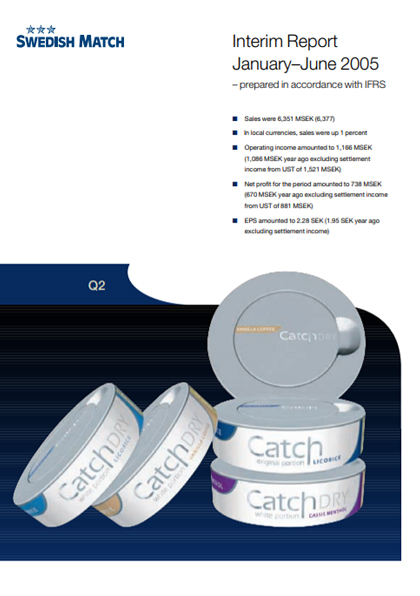
As a result of the sale, Swedish Match has strongly advanced its position as one of the world's leading producers of smokeless tobacco - snuff and chewing tobacco. Combined with brown tobacco - cigars and pipe tobacco - these products form the base of our new strategic platform. Our expansion will take place in these two sectors of the tobacco market. And the reason is quite simple - particularly with regard to snuff -these are the areas where we see inherent organic growth that presents clearly discernible potential for future growth.

Smokeless tobacco is a product area with a much greater geographic spread than most people realize. In addition to the Nordic countries and North America, markets in large parts of Africa, the Middle East and India are also characterized by substantial consumption. It is only a niche sector of the large global tobacco market, but it has sustained organic growth of 4 to 5 percent annually in countries where we conduct operations - Scandinavia, South Africa and the U.S.

This growth in market demand is the focal point of our strategy and the main driving force in our expansion. Swedish snuff is our spearhead product, and I would like to take this opportunity to thank everyone in our company for their efforts in developing our world-class technology. Behind our snuff products, in fact, is a relatively complicated, high-tech production process with extremely high quality demands. This applies in particular to portioned snuff, which is also our strongest growth product. We believe Swedish Match has established a technological lead, in addition to our unique portfolio of branded products, as well as global leadership in market know-how and distribution skills.

Brown tobacco, our other growth area, consists of cigars, a market with strong potential in many parts of the world and increased opportunities for consolidation, and pipe tobacco, which is characterized by a steady decline in consumption but high margins. In this sector, our strategy calls for expansion partly through acquisitions. During recent years, the ongoing process of structural change has gained greater momentum, with Swedish Match and several other players advancing their positions through acquisitions and mergers. In 1999, we were one of the market's most active players, with three significant acquisitions.

The driving force has been our brand positioning and the need for greater critical mass to improve cost-efficiency in production, marketing and distribution. We are also forced to work under restrictions in the form of advertising bans in many key markets, which strongly limit opportunities to launch and nurture new product brands. As a result of our acquisitions last year, I believe that Swedish Match now has a very strong portfolio of brand-name products that represent highly significant values for our shareholders.

We started by acquiring the American company General Cigars' operations for machine-made cigars in the U.S. The acquisition immediately established Swedish Match as one of the largest cigar companies in the world, with a market share of 11 percent and strong positions in the world's largest single market.

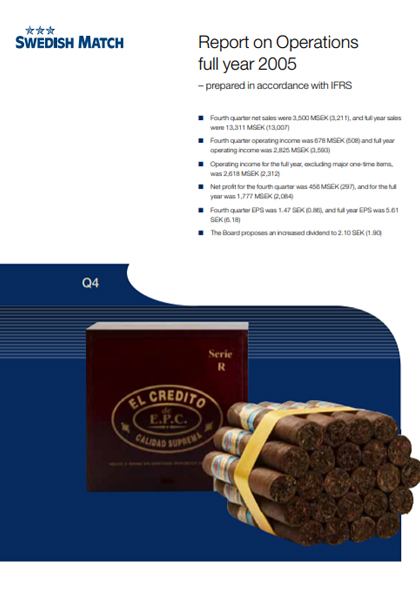
Later in the year, we acquired El Credito, which provided Swedish Match with La Gloria Cubana, one of the American market's leading premium brands of handmade cigars.

And we must not overlook our acquisition of Leonard Dingler, the market leader in South Africa. The company has a very strong position in the market for pipe tobacco and highly promising snuff operations in a market characterized by significant growth in the range of 3 to 5 percent annually. The acquisition has started our expansion on the very interesting African continent.

In addition to growth opportunities, our strategic package also contained such components as structural change and reduced operating costs.

Last year, we introduced a new organization whereby we abandoned the matrix organization with 15 units and established six divisions with clear profit responsibility. The new structure has enabled us to cut costs sharply throughout the Group. The process of change has been successfully implemented and this first step is virtually completed.

Structural change and cost reductions have also been the theme of our remaining product category - lighters and matches. We have favorable market positions for both products. The Lighter Division is the world's third largest manufacturer of disposable lighters. In matches, we are the industry's only global production company.

As shareholders, you are fully aware that we have shown weak earnings from these business activities. They operate under tough market conditions, facing strong competition from hundreds of companies in countries with low production costs. During the past few years, they have also faced pressure from weak economies in large important markets characterized by virtually stagnant demand.

The operations are strategically important to the Group, however, based on their global spread with sales in 140 countries, which provides distribution channels, market know-how and local presence.

Our strategy, therefore, has been to work with their profitability problems, to work actively with restructuring and cost reductions.

And I am very pleased to announce that our strategy is beginning to bear fruit, first and foremost for our lighter activities. We have closed a large production plant within lighter operations and generally adjusted the Lighter Division's fixed costs, which has led to a gradual improvement in profitability.

What results did we achieve through our strategic efforts in 1999?

Let us quickly review the income statement and balance sheet, which you have already seen, and examine some important key ratios before we begin to look into the future.

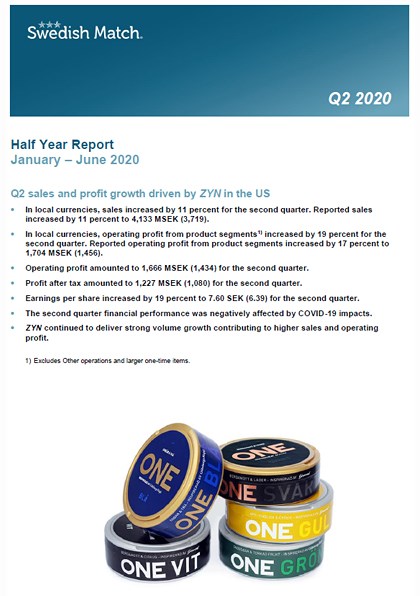
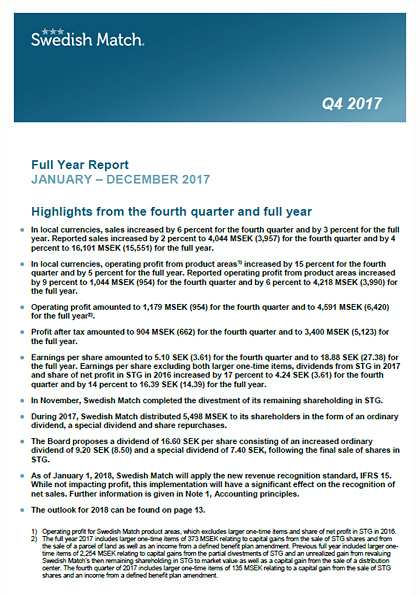
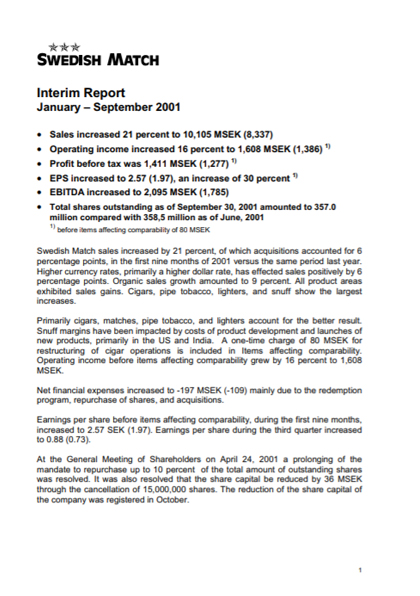
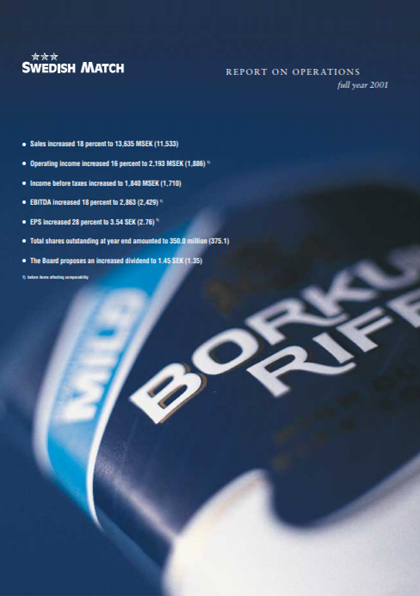
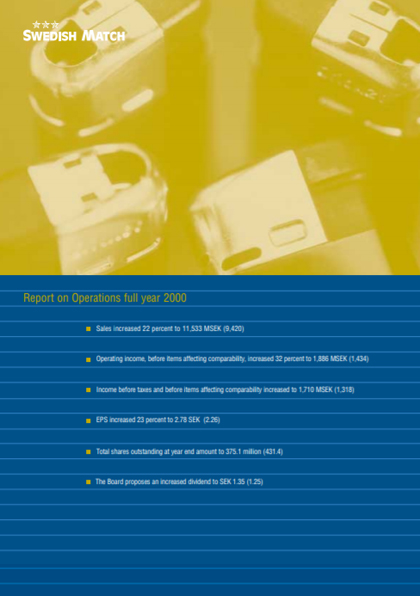
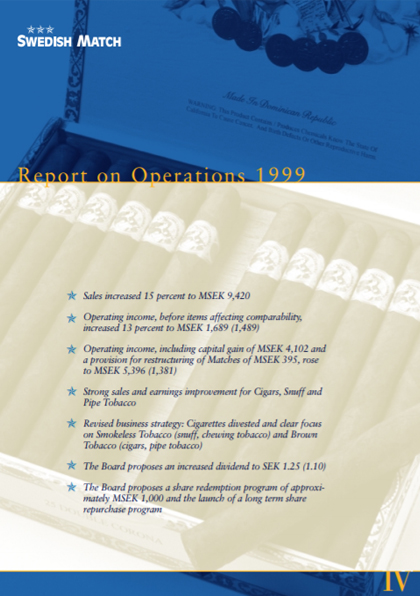
  • Consolidated net sales increased by 15 percent to SEK 9,420 million. Acquisitions accounted for 9 percent of the increase.
  • Operating income increased by 13 percent to SEK 1,689 million before items affecting comparability. The marginal decline in our operating margin was due to the sale of cigarette operations and, in the future, cigarette activities in the Swedish market will be restricted to distribution. Revenues from distribution activities are reported under Group sales, but generate a lower margin than our former cigarette operations.

As a result, we have reversed the trend of declining operating income - a sign of our growth and internal operating efficiency. For the sake of completeness, I should also mention that operating income, including capital gains from the sale of cigarette operations, amounted to SEK 5,396 million.
  • Balance sheet effects of our results in 1999 include a strong increase in the equity/assets ratio, which amounted to 37 percent at year-end. Our cash assets and short-term investments exceeded interest-bearing liabilities by SEK 1,267 million. Your company, accordingly, has strong financial freedom of action to pursue continued expansion through acquisitions and interesting opportunities to transfer profits to our shareholders. I will return to this subject later.

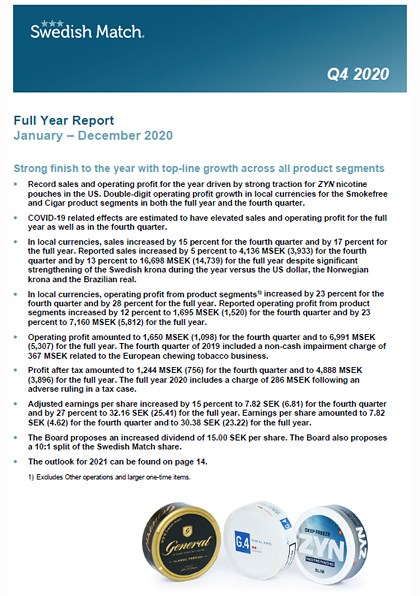
Operations during 1999 provided our company with continued and highly competitive key ratios. The operating margin was slightly more than 18 percent. Earnings per share increased nearly 18 percent to SEK 2.31, before items affecting comparability.

Let me also comment of some of our product areas.

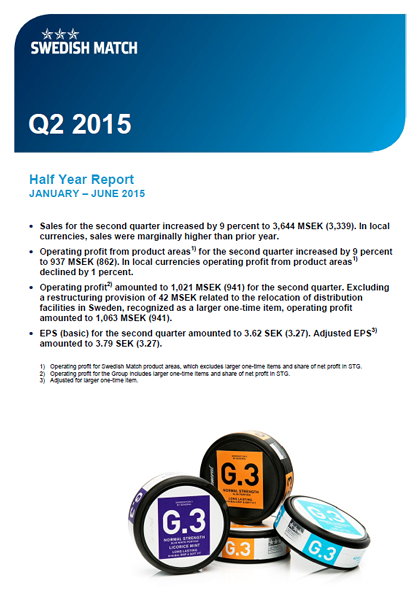
The product area for smoke-free tobacco, snuff and chewing tobacco, showed strong growth of 15 percent in 1999. Snuff performed especially well, with sales rising 26 percent. Sales in the American market were highly favorable, with volumes up 44 percent and market share rising by 1.6 percentage points to 6.6 percent.
Sales of chewing tobacco were unchanged in Swedish currency but declined marginally expressed in local currencies, and the operating income was down 10 percent. As a result of intensified marketing, the Group recaptured market shares we lost due to negative business trends during the preceding year. The operating profit for the entire product area increased by 16 percent.

A strong growth also characterized brown tobacco, that is, pipe tobacco and cigars, which rose 66 percent, mainly on the strength of acquisitions. Operating income more than doubled during the past year.

The Match and Lighter product area showed sales increases of 1 percent, which was primarily due to the acquisitions within the match operations that were carried out in 1998. Lighter operations showed decreased sales and decreased operating profit in 1999 because of weaker economic conditions in Eastern Europe at the end of 1998. The operating profit for the entire area fell by 20 percent, which showed the necessity of major restructuring.

If we turn our attention to the future and look at operations this year, now that we have completed the first quarter, what are the evaluations and outlooks of management and the Board of Directors?

First and foremost, I want to make it perfectly clear that we shall continue to pursue our present strategy.

Determined efforts will continue to be focused on our growth markets - smokeless tobacco and brown tobacco - which offer organic growth potential in many global markets. We expect snuff sales to continue to increase at the same rate as last year in our main markets in Scandinavia and the U.S. We have initiated a comprehensive branding program for snuff products, which in the long-term perspective will gradually strengthen our grip as the market leader.

We are also studying and testing various ways to expand our comprehensive know-how in smokeless tobacco to include new markets. This is an exciting and challenging task that requires a great deal of attention and understanding with regard to local consumption cultures, market conditions, local raw materials and production conditions. It is a time-consuming process that will almost certainly take a few years to implement, but it also offers very significant potential. As shareholders, you will be provided with continuously updated information about important steps in this endeavor.

A dramatic change would be achieved if not only the warning label that is now printed on our snuffboxes were removed, but also if EU lifted its ban on snuff sales. The ban was introduced before Sweden became a member of EU, and the main reason was that snuff was assumed or alleged to be a carcinogenic. Research has shown there is no basis for the assumption. As a result, the EU Commission has proposed that the misleading warning text "Causes cancer" should now be replaced by "May be hazardous to your health," a claim, I might add, that could be put forth concerning most products on the market today.

This is all well and good. Consumer information is important. Even more important, however, is correct and relevant information. Otherwise, there is a risk whereby the credibility of similar warnings could be undermined. Now that the EU Commission has concluded that there is no basis for the claim that snuff might cause cancer, it would be only natural to also lift the ban on snuff sales.

For reasons that are self-evident, we are now facing very substantial consolidation and rationalization work in our cigar operations. We must make every effort to take maximum advantage of the large companies we acquired last year, to integrate production, administration and marketing in order to derive maximum synergy effects. These are very demanding processes that will require a great deal of time and hard work by our employees.

Structural changes in the cigar market will continue parallel with market growth in several parts of the world. The American market appears slightly weaker than last year at this time, but it is too early draw any major conclusions for the full year. Our goal is to continue to grow at a pace that exceeds growth in our markets, supported by operating improvements in all aspects of our operations and continued acquisitions. We have the same goal for pipe tobacco, a market characterized by strong fragmentation that might offer good opportunities for interesting acquisitions.

In our match operations, we shall continue to focus on internal restructuring to adapt our production capacity to current market demand. We are extremely determined to succeed in our efforts to increase margins and profitability to acceptable levels. I am hopeful that we will show improved earnings within 2-3 years.

I should also mention that our focus on growth will require important elements of research and development. We are now allocating resources for innovative projects that seek new directions.

One of these projects is our joint venture with Gum Tech International, an American company in which we own 51 percent of equity. With initial venture capital of USD 10 million, the company will study new business opportunities for non-tobacco based nicotine products. We have noticed a steady increase in the control of tobacco operations in all parts of the world, in parallel with reverse conditions for nicotine products that are not based on tobacco. These products will soon be sold in the same shops and stores that sell tobacco. And we intend to be positioned strongly when that day comes.

I have spoken at length today about our business strategy, and it would be highly remiss if I did not mention the development of our skills and personnel. With employees in so many different countries, this is an interesting and challenging task. Swedish Match has longstanding and honorable business traditions, which we shall continue to develop as we take on large numbers of new employees through acquisitions.

Skilled and committed management personnel are a key factor. We are focusing strongly on professional leadership through a number of different programs. A random selection of program names reflects the breadth: international management program, senior management program and international trainee program. The content of these programs focuses on international relations, leadership in difficult conditions and entreprenuership.

After reviewing present market conditions and our strategy, I shall now present a brief summary of Group operations in the beginning of year 2000 - a review of our results in the first quarter.

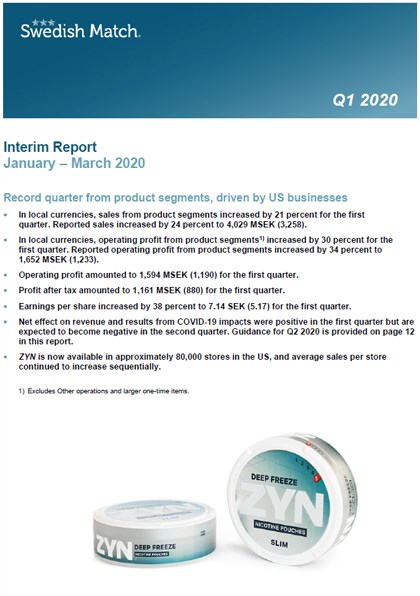
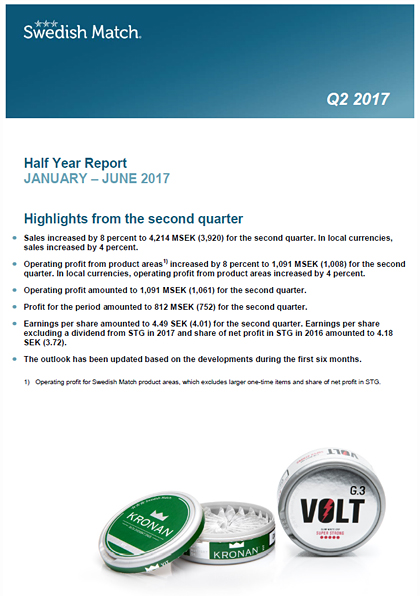
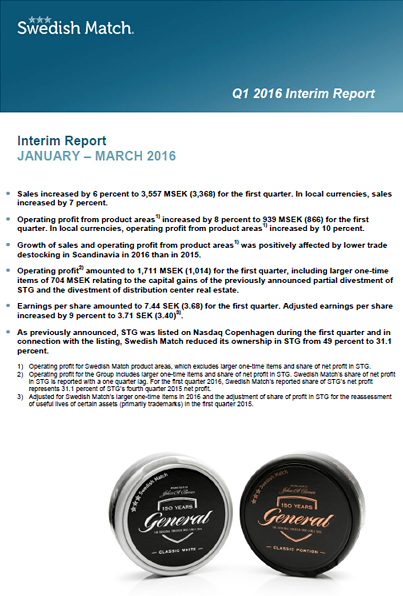
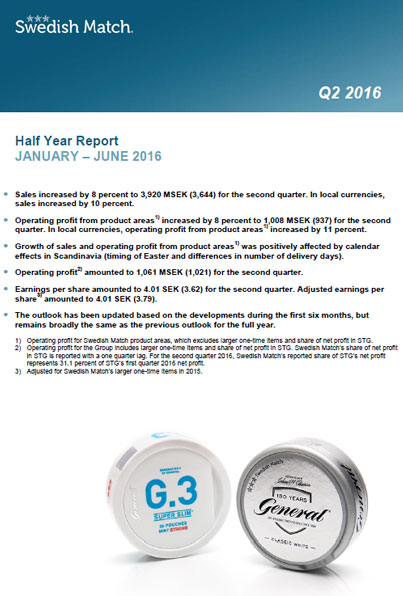
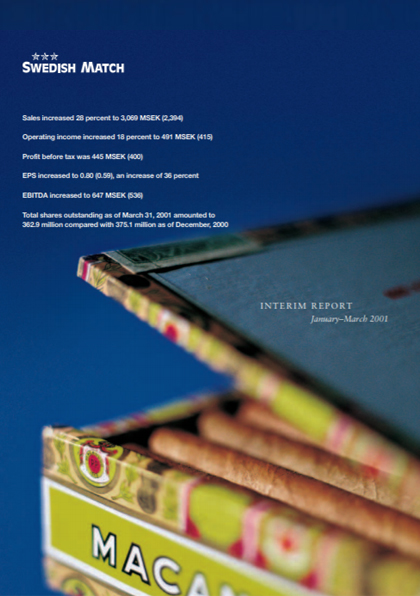
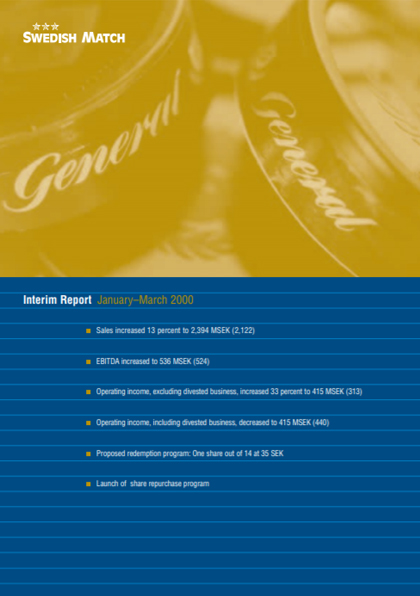
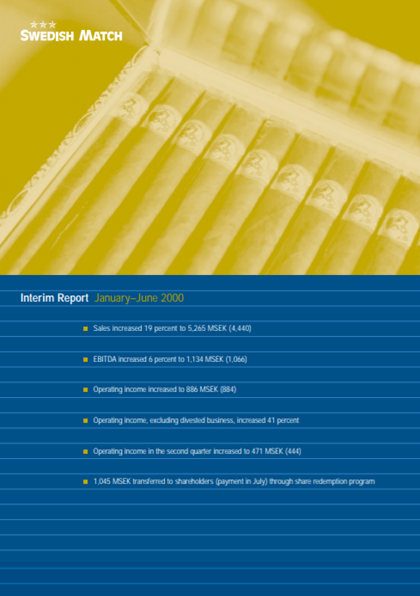
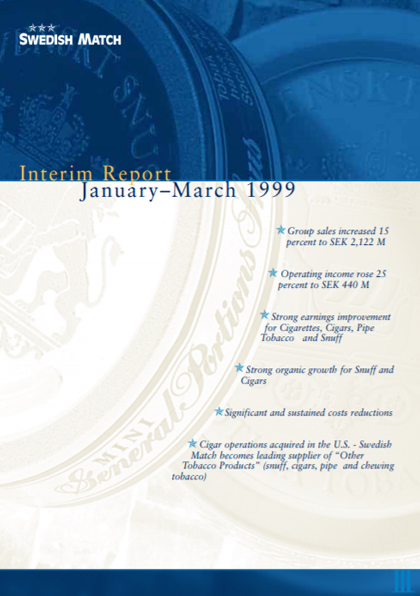
Sales increased by 13 percent to SEK 2,394 million.

Operating income, excluding the divested cigarette operations, rose 33 percent from SEK 313 million to SEK 415 million. Profits for 1999, including divested cigarette operations, totaled SEK 440 million.

Strong development continued during the first quarter for both of our growth product areas - Smokeless Tobacco, which consists of snuff and chewing tobacco, and Brown Tobacco, comprising cigars and pipe tobacco.

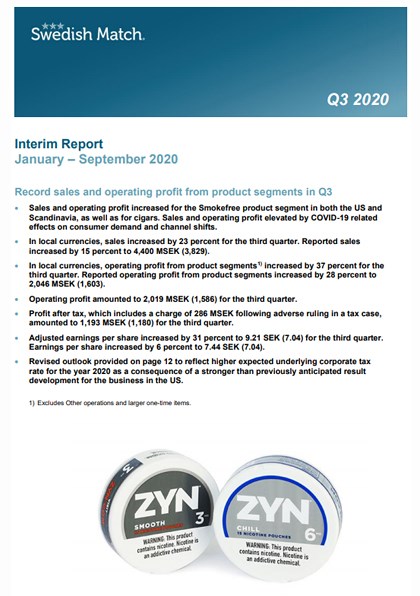
Sales of smokeless tobacco products rose by more than 16 percent. The 22-percent increase in sales of snuff products was especially large and was primarily attributable to higher volumes in the US. Despite increased costs for product development and marketing activities, operating income increased by 11 percent. Snuff and chewing tobacco considerably increased market share in the US.

Sales of Brown Tobacco more than doubled. Operating income increased by 80 percent. The cigar operations had sales increases of 81%, which was primarily due to acquisitions in the US. Pipe tobacco operations also reported a strong increase in sales, which was also due mainly to a recent acquisition - the activities of Leonard Dingler in South Africa.

Demand for matches continued to decline in Europe, which resulted in a 13-percent decline in sales for Group match activities in the first quarter. Structural changes were initiated several months ago to improve the operating margin from match activities to 10 percent within the next few years. The Lighter Division has begun to see the light at the end of the tunnel and both sales and operating profit increased. Improved earnings are a result of restructuring and increased capacity utilization. In total, sales for the entire product area decreased by 8 percent. Operating income increased by 32 percent.

One of the most important events during the first quarter was the agreement to acquire a 64 percent share in General Cigar, pending approval by an Extraordinary General Meeting of shareholders in General Cigar on May 8. We have been given authorization from the authorities to complete the acquisition.

During the first quarter of year 2000, we also reached agreements to acquire the chewing tobacco brands and operations of National Tobacco, an American company. The acquisition is conditional, pending the approval of the American competition authority.

Last, but certainly not least important, I shall return to our main theme - efforts by Swedish Match to create value for our shareholders. At last year's Annual General Meeting, we described a program formulated by the Board of Directors to transfer surplus funds to shareholders. It should be obvious to everybody who has studied Swedish Match that our company has a very unusual position in today's stock market, with particular regard to profit capacity and financial strength. Our position is so strong that the company generates substantial cash flow every year, which, despite our aggressive growth strategy, provides the potential for high return on the company's capital.

Our generous dividend policy is an expression of our financial strength. Over the long-term perspective, we strive to pay dividends corresponding to 40-50 percent of our consolidated net profit. The Board of Directors has hedged this declaration with a stipulation whereby the time and size of dividends will be decided from one year to the next, depending on normal business considerations to secure the company's continued long-term dividend capacity.

Today, also the legislation governing purchases of our own shares has been enacted and, accordingly, a proposal has been submitted to this Annual General Meeting regarding three measures for the transfer of profits to shareholders.

  1. Dividend
  2. Redemption of shares valued at approximately SEK 1,000 million,
  3. and a program to repurchases shares in the company

Page updated May 9, 2008

SWMA Jul 3, 2008 6:00 PM CET 118.5 SEK +3.0% Up


Addresses

Stockholm
Swedish Match Corporate Headquarters SE-118 85 Stockholm
Phone: +46 8 658 0200
Fax: +46 8 658 3522
Search more addresses
Would you like to order Swedish snus?