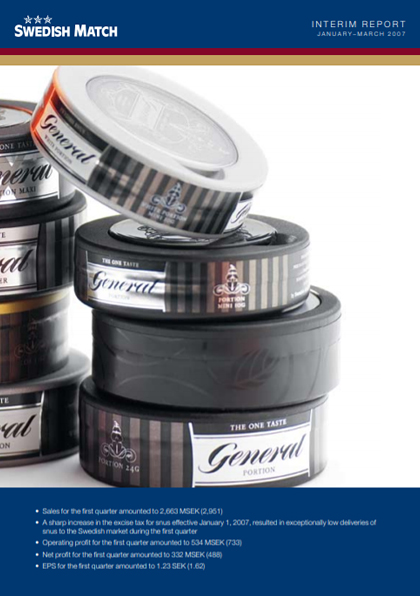
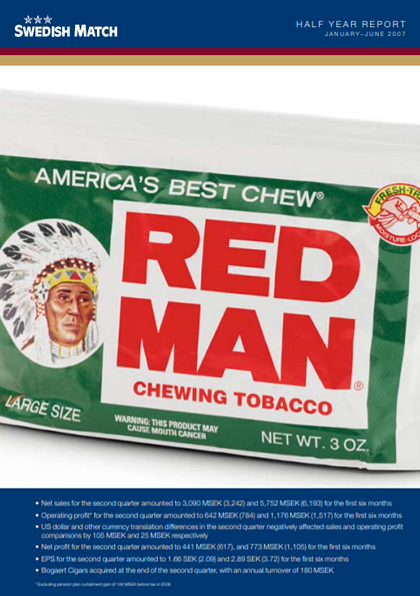
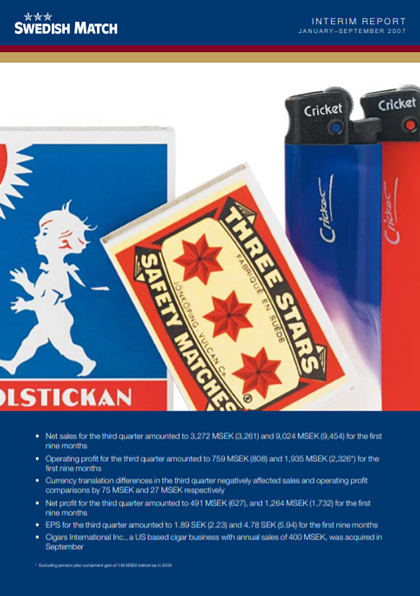
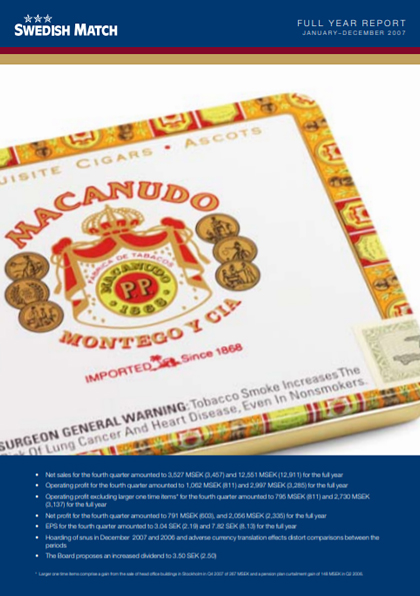
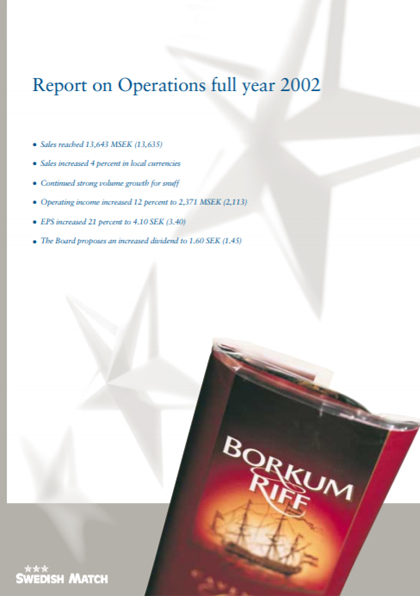
- Income after net financial
items rose to SEK 1,558 M (1,530)
- Consolidated sales in 1997
amounted to SEK 7,465 M (7,416), the same level as a year
earlier.
- Increases in Swedish tobacco
taxes during the year total 63%. Taxed cigarette sales in
Sweden declined by 27%.
- Sales for Snuff rose 20% to
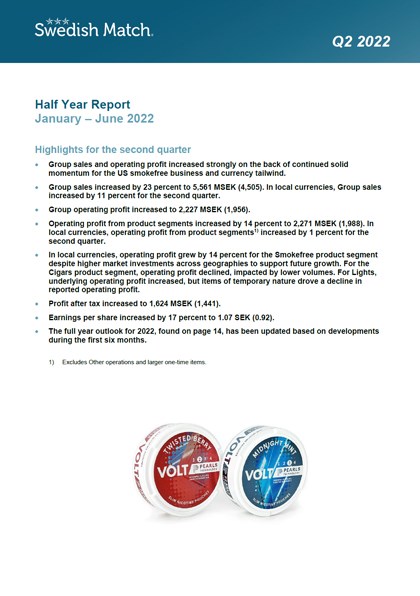
SEK 1,079 M and operating income by 21% to SEK 522 M.
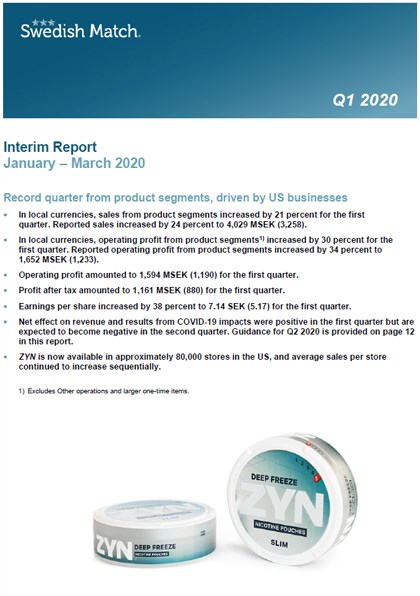
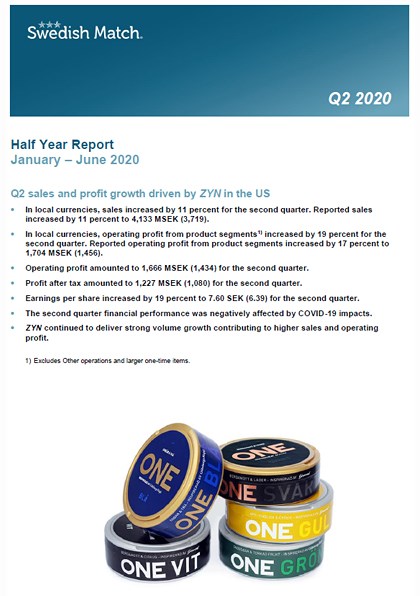
Market share in the U.S. rose from 2.3% to 3.2%.
- Smokeless tobacco’s
share of operating income increased to 51% (41).
Cigarette’s share fell to 29% (41).
- During the year interests in
production companies in Turkey, Finland, Bulgaria and
India were acquired. In addition, a distribution company
in Sweden was acquired.
- Income per share was SEK 2.25
(2.39).
- Proposed dividend per share
for 1997 SEK 1.10 (1.10), corresponding to SEK 510 M.
- Share redemption for
approximately SEK 1,200 M proposed by the Board.
Swedish Match sales during 1997
amounted to SEK 7,465 M (7,416). Sales were affected positively
by a currency effect of 5%. Higher sales by several divisions,
particularly the Snuff Division, compensated for lower sales by
the Cigarette Division.
Operating income, before items
affecting comparability, amounted to SEK 1,586 M (1,723) after a
positive currency effect of 5%. Lower operating income reported
by the Cigarette Division could only be partly offset by
improvements from smokeless products and matches.
Summary of Consolidated Income
Statement
| (SEK M) |
1997 |
1996 |
| Sales |
7,465 |
7,416 |
Operating
income before
items affecting comparability |
1,586 |
1,723 |
| Operating
income |
1,586 |
1,600 |
| Income after
net financial items |
1,558 |
1,530 |
| Net
income |
1,045 |
1,109 |
Sales by Division
| (SEK M) |
1997 |
1996 |
Percent change |
Chewing
Tobacco |
1,149 |
1,043 |
10 |
| Cigarettes |
1,546* |
1,983 |
-22 |
| Cigars |
691 |
678 |
2 |
| Lighters |
834 |
846 |
-1 |
| Matches |
1,299 |
1,241 |
5 |
| Pipe Tobacco |
166 |
196 |
-15 |
| Snuff |
1,079 |
900 |
20 |
Group-wide
operations
and eliminations |
701* |
529 |
33 |
| Total |
7,465 |
7,416 |
1 |
* After May 1, 1997, external
invoicing of Prince cigarettes is reported under Group-wide
operations.
Subcontracted production remains within the Cigarette Division.
The change results in SEK 121 M of
total Prince sales during May-December of SEK 340 M being
reported in the Cigarette Division and
SEK 219 M under Group-wide operations.
Operating income before items
affecting comparability, by division
| (SEK M) |
1997 |
1996 |
Percent change |
| Chewing
Tobacco |
420 |
368 |
14 |
| Cigarettes |
537* |
789 |
-32 |
| Cigars |
131 |
136 |
-4 |
| Lighters |
53 |
48 |
10 |
| Matches |
147 |
118 |
25 |
| Pipe Tobacco |
28 |
41 |
-32 |
| Snuff |
522 |
431 |
21 |
Group-wide
operations
and eliminations |
-252* |
-208 |
-21 |
| Total |
1,586 |
1, 723 |
-8 |
* Most of the contribution from
sales of Prince cigarettes is reported under the Cigarette
Division.
Chewing Tobacco
The Chewing Tobacco Division operates solely in the North
American market, primarily in the U.S.
Sales amounted to SEK 1,149 M
(1,043), an increase of 10% compared with 1996. The increase was
attributable to price increases and the strong U.S. dollar.
Operating income rose to SEK 420 M (368), an increase of 14%.
Expressed in local currency (USD), sales declined 3%, compared
with 1996, while operating income was unchanged. The chewing
tobacco market in the U.S. during the 1990s has declined 2-3%
annually. The market decline appears to be greater in 1997.
Cigarettes
The Swedish market accounts for 80% of sales invoiced by the
Cigarette Division. The Division also sells cigarettes to Estonia
and to the taxfree market as well as cigarette papers and related
products in the U.K.
Sales by the Cigarette Division in
1997 amounted to SEK 1,546 M (1,983), down 22%. The decline is
attributable mainly to the sharp volume drop on the Swedish
market. As a result of hoarding in the Swedish market toward
year-end 1996, triggered by the increase in tobacco tax and
prices that took effect on January 1, 1997, estimated sales of
SEK 75 M that would normally have been made in 1997
were invoiced toward year-end 1996. Favorable sales were reported
for Estonia, UK and the taxfree market.
The new agreement with
Skandinavisk Tobakskompagni A/S (STK) regarding sales of Prince
cigarettes came into effect on May 1, 1997. Under terms of the
agreement, Swedish Match is responsible for production and
distribution of Prince cigarettes, and STK, through its
subsidiary House of Prince, is responsible for sales and
marketing.
SEK 160 M of the Division’s
sales decline is attributable to lower price levels on deliveries
of Prince cigarettes from the Division to Tobaksvaruimporten
(external invoicing is carried out from Tobaksvaruimporten which
is reported under Group-wide).
The Division’s operating
income amounted to SEK 537 M (789). The effect on earnings of the
volume decline could only be offset by a third through price
increases. The effect of hoarding on operating income toward
year-end 1996 has been estimated at approximately SEK 45 M.
Earnings were charged with the costs incurred in conjunction with
the relaunching of the new Blend and to meet the stiffening
competitive situation on the Swedish market. However, profit
improvements were reported for Estonia, U.K. and the taxfree
market. Compared with 1996, the new Prince agreement affected the
Division’s operating income adversely by about SEK 60 M.
However, an additional SEK 16 M was reported for distribution
compensation, under Group-wide operations.
The total Swedish market for
cigarettes declined during the year by 27 % (6% due to the
hoarding effect as a result of the tax increase last year), from
sales in 1996 of 8.3 billion cigarettes to 6 billion in 1997. The
decline in volume is strongly correlated with the two tax
increases on tobacco during the year totaling 62.8 %. The effect
of the tax increases will gain full impact on sales during 1998.
The market share for Swedish Match’s products amounts to
slightly more than 50%. All indications are that the decline in
consumption is substantially less than the 27 % die to a sharp
increase in smuggling, cross-border, post-order and taxfree
sales.
As a result of lower deliveries,
tobacco tax for cigarettes paid by Swedish Match in Sweden during
1997 declined by 0.6 % to SEK 6,343 M, despite an average tax
increase during 1997 of about 40 %.
Cigars
The Cigar Division is one of the world’s largest producers
of cigars and cigarillos. Western Europe is the most important
market for the Division.
Sales in 1997 totaled SEK 691 M
(678). Operating income declined to SEK 131 M (136). A temporary
decline in the Netherlands and costs incurred for the
introduction of new products and the investment in the U. S.
market are the main reasons for the income decline.
Continued introduction of premium
cigars, so-called long fillers, with test sales and initial
market investments was carried out in the U.S. resulting in a
certain volume increase, concurrent with an adverse earnings
impact for the Division. A total of about one million hand-rolled
cigars, which were produced at the Division’s unit in
Indonesia, were sold during the year. In addition to hand-rolled
cigars, wrappers and binders are produced in Indonesia for the
European plants. Accordingly, the currency crisis in Asia has a
certain positive effect on the Division’s earnings. If the
political situation in Indonesia is growing worse it is a
possibility that it can cause problems in the production.
Production in Härnösand, Sweden, was shutdown in 1997 and
transferred to the Division’s factory in Belgium.
At the end of November, Swedish
Match acquired R.J. Reynolds cigar production and cigar brands in
Finland, which has an annual volume of 50 million cigars,
corresponding to SEK 80 M, and an 67% share of the Finnish
market. R.J. Reynolds will continue to handle sales and
distribution. Co-determination negotiations with employee
representatives in Finland were concluded, resulting in the
shutdown of the plant in Jakobstad during September 1998 and
transfer of production to the Belgian factory.
Lighters
Swedish Match is the world’s third largest manufacturer of
disposable lighters, with annual production of about 400 million
lighters. The most important markets are Western Europe, Eastern
Europe, the U.S. and certain parts of Asia.
Sales amounted to SEK 834 M (846),
a decline of slightly more than 1% compared with a year earlier.
Operating income increased to SEK 53 M (48), which resulted in a
some-what higher profit margin, 6.4% (5.7). Delivered volumes
fell by 3.5% due mainly to lower sales in the U.S. market. The
year’s earnings include costs totaling SEK 10 M for
rationalization of the plant in Manila, Philippines. Cost savings
were achieved due among other factors to a sharp reduction in
range and increased automation in production. Both sales and
earnings were affected favorably by currency exchange rate
trends.
Matches
The Match Division is the world’s only global match
manufacturer. The Division sells matches primarily in Europe and
Brazil, but also has large export volumes to other market
worldwide. The Division also produces machinery for match
production through Swedish Match Arenco.
Sales increased during the year by
5% to SEK 1,299 M (1,241). Lower volumes in the European match
market and low sales from Arenco have been more than compensated
for by higher prices and currency gains.
Operating income increased by 25 %
to SEK 147 M (118). In addition to factors mentioned above,
production rationalization measures implemented mainly in Brazil
also had favorable effects on the Division’s operating
income. The Brazilian market, which is important for Swedish
Match, is moving toward stabilization, with improved margins as a
result.
During the autumn, Swedish Match
and Kav Orman San S.A. signed a joint-venture agreement for
development of matches and other Swedish Match products in Turkey
and other countries in the region. Under terms of the agreement,
a new company will be established in Turkey in which Swedish
Match will own 60%. Kav will make a non-cash transfer of its
existing match operations (sales of SEK 100 M), which currently
holds a 40-50% share of the Turkish market.
In December 1997, Swedish Match
acquired the majority in two investment companies in Singapore,
which hold 39 % of the shares in Wimco Ltd, an exchange-listed
Indian match company. Wimco is one of the largest single match
producer in the world and also has one of the most well-developed
distribution networks for consumer products in India. Sales for
the match operation within Wimco amount to about SEK 375 M.
Toward the end of the year,
Swedish Match entered into an agreement regarding the acquisition
of 58% of the shares in PLAM Bulgarski Kibrit JSCo, which is
Bulgaria’s dominant match producer, with sales of about SEK
35 M. Half of the matches produced are exported to neighboring
countries.
Through these aforementioned
acquisitions, Swedish Match intends, in cooperation with local
partners with local knowledge and experience, to expand with
matches, lighters and tobacco products into new markets.
Pipe Tobacco
The Pipe Tobacco Division is one of the world’s largest
producer and seller of pipe tobacco, with a world market share of
about 10% in volume. The most important markets for the Division
are the U.S., Sweden and the rest of Western Europe.
Sales in 1997 fell 15% to SEK 166
M (196) and operating income by 32% to SEK 28 M (41). The sales
decline is attributable mainly to weakening main markets and the
earlier deliveries at the end of 1996.
In Sweden, the plant in Arvika was
closed and production moved to the Malmö plant. In the U.S., the
rights to market Borkum Riff on the North American market were
acquired from US Tobacco. This is expected to result in increased
sales and improved earnings in 1998. The agreement with US
Tobacco is from the period prior to Swedish Match establishing
own operations in the U.S.
Snuff
The Snuff Division’s largest markets are Sweden, including
taxfree (82% of sales) and the U.S. (15%).
Sales rose 20% during 1997 to SEK
1,079 M (900) The increase in sales was attributable to higher
volumes in the U.S. market and higher prices in Sweden.
Operating income improved by 21%
to SEK 522 M (431). In addition to the afore-mentioned factors,
operating income was affected favorably in Sweden by the rise in
the share of portion-packed, measured in number of snuff cans, to
nearly 40%.
The tax increases in Sweden during
1997 affected domestic sales somewhat negatively in volume, but
this was offset by a more than 60% increase in taxfree sales.
Market shares in the U.S. market rose during the year from 2.3%
to 3.2%. Market-leading US Tobacco initiated a low-price campaign
in August. The Snuff Division responded to the challenge by
reducing the price on its main product, Timber Wolf, from USD
1.10 to USD 0.70 per can. A price increase from USD 0.70 to USD
0.90 was implemented by US Tobacco near the end of the year.
Group-wide operations
The net costs for the Group-wide operations increased to SEK 252
M (208). The figure includes costs for participation as a sponsor
in the Whitbread Round the World Race, an international yachting
competition, and costs incurred for the Swedish Match Global
Challenge, an internal project. Costs for these projects are
estimated to be in the same range during 1998. In accordance with
the Group’s new structure introduced on January 1, 1997, the
Swedish Match Global Challenge is designed to strengthen global
coordination of Group operations and strengthen worldwide
business activities.
Tobacco tax increases in Sweden
During the year, the tobacco tax was increased by 25% on January
1 and by 30% on August 1. In conjunction with these hikes,
Swedish Match‘s prices were increased. The price increases
for two of the most important products are shown below. During
1997, Swedish Match debited customers in Sweden with tobacco
taxes and VAT on tobacco products in an amount of SEK 9,387 M
(9,155),
Blend Gul
cigarettes
(fixed highest price) |
|
|
|
| |
At Jan. 1, 1996 |
At Jan. 1, 1997 |
At August 1, 1997 |
Sales price
Swedish Match |
4.38 |
4.76 |
5.28 |
| Retail
margin |
5.11 |
5.25 |
5.40 |
| Excise tax |
15.31 |
19.19 |
24.92 |
| VAT |
6.20 |
7.30 |
8.90 |
| Price to
consumer |
31.00 |
36.50 |
44.50 |
General
snuff
(base price) |
|
|
|
| |
At Jan. 1, 1996 |
At Jan. 1, 1997 |
At August 1, 1997 |
Sales price
Swedish Match |
4.65 |
4.98 |
5.53 |
| Retail
margin |
4.00 |
4.62 |
5.52 |
| Excise tax |
3.75 |
4.80 |
6.15 |
| VAT |
3.10 |
3.60 |
4.30 |
| Price to
consumer |
15.50 |
18.00 |
21.50 |
Preliminary agreement in the
U.S.
During the year, Philip Morris Incorporated, R.J. Reynolds
Tobacco Company, Brown & Williamson Tobacco Corporation,
Lorillard Tobacco Company and United States Tobacco Company
reached a preliminary agreement with 39 states which among other
things would settle suits filed against these companies in the
U.S.
In exchange for these suits being
withdrawn and certain limitations regarding future suits
involving product liability, the five companies agreed to make
payments which during the next 25 years amount to nearly USD 370
billion. In accordance with the preliminary agreement, the five
companies have accepted new restrictions on production, marketing
and distribution of cigarettes and smokeless tobacco products
sold in the U.S. (the agreement does not cover pipe tobacco and
cigars). The proposed agreement is conditional upon these
conditions being included in new legislation. If the settlement
were enacted as proposed, it would have a significant impact on
the tobacco industry in the U.S., including Swedish Match’s
operations.
The proposed settlement has been
widely debated and critized. At this time it is not clear whether
and to what extent, legislation implementing the proposed
settlement, or any parts thereof will be enacted. It is
impossible at this time, therefore, to speculate over potential
effects of an agreement on the business activities of Swedish
Match in the U.S. market.
Income per share and proposed
dividend
Income per share was SEK 2.25 (2.39). In accordance with the
company’s dividend policy, the Board has decided to propose
that the Annual General Meeting distribute SEK 1.10 (1.10) per
share to the shareholders. The proposed dividend for the year
corresponds to 49% of net income.
Redemption of shares
Within the framework of the shareholder program (page 7 and 8)
and considering Swedish Match’s strong financial position
and substantial transfer capacity, the Board of Swedish Match has
decided in addition to the ordinary dividend for fiscal year 1997
to propose the redemption of Swedish Match shares to the Annual
General Meeting on April 29, 1998. Through the redemption,
capital which is no longer required in operations is transferred
to the shareholders. This reduces shareholders’ equity and
the number of shares. The redemption will be proposed in an
amount in the range of SEK 1,200 M.
More detailed information on the
exact terms and conditions will be provided in mid-April, but not
later than April 22. A Special General Meeting is planned to be
held on or about July 7, after which the redemption amount is
expected to be paid at the end of July.
Financial result
Net interest expense amounted to SEK 17 M (expense: 81). Other
financial items, an expense of SEK 11 M (income: 11), net, are
attributable to exchange gains and losses on financial assets and
liabilities. Most of the exchange losses were incurred in the
subsidiaries in Indonesia and the Philippines.
Investments, financing and
liquidity
Group investments in tangible assets during the year totaled SEK
292 M (217). Depreciation according to plan amounted to SEK 268 M
(270). Liquid assets, including short-term investments, totaled
SEK 563 M at the close of the period, compared with SEK 942 M at
year-end 1996. Liquid assets include bank accounts and bank
deposits. Net debt at the close of the period was SEK 471 M, an
increase of SEK 394 M since December 1996. Net debt was low at
year-end 1996 because liabilities for income tax and tobacco
excise taxes were approximately SEK 500 M higher than normal. The
liabilities have since been paid down and reduced to a normal
level. During the year, the Group raised a three-year,
fixed-interest bond loan in the amount of SEK 200 M. The loan was
financed primarily by a Swedish commercial paper program with a
loan framework of SEK 2,000 M, of which SEK 777 M had been
utilized as of December 31, 1997. In addition, there is a
syndicated bank loan, with a line of credit of SEK 2,000 M, which
was entirely unutilized at December 31, 1997.
Average number of Group
employees
The average number of Group employees 1997 was 6,467, compared
with 6,580 during 1996. The average number of employees in Sweden
was 1,485, compared with 1,467 last year.
Capital structure
In February 1998, the Board of Directors and management of
Swedish Match concluded an extensive analysis of the
company’s long-term financial situation and structure. The
analysis work resulted in the further development of existing
financial goals, the addition of new financial goals and that the
Board has issued a new program statement for the transfer of
surplus funds to the shareholders, a shareholder program.
Financial goals
- Average return requirement on
acquisitions and new investments
Acquisitions and expansion investments aimed at organic growth in
existing operations must provide a return of at least 10% after
tax on invested shareholders’ equity. The requirement
pertains to investments in Swedish kronor at current inflation
and interest levels. The return requirement for individual
investments and acquisitions varies depending on type of
investment, product area and geographic market. Based on specific
conditions, each major separate investment is assigned an
individual risk premium.
- Debt/equity and interest
coverage ratios
The goal is that the debt/equity ratio should not exceed 100 %
long term. With the prevailing balance sheet structure, this
corresponds to an equity/assets ratio of about 30%. Interest
coverage should, at current interest levels, be not less than 10.
Shareholder program
- The Board has made the
following program statement for transfer of surplus funds to the
shareholders:
"Under the condition that the goals set for the Group’s
financial risk-taking are fulfilled, the Board will, in addition
to the ordinary dividend, consider transfer in a proper manner of
the surplus funds, which are considered not to be necessary for
the Group’s expansion and consolidation, to the
shareholders. The form for the transfer will be determined at any
given time based on a combined assessment of available methods
and the total effects for the Swedish Match Group and its
shareholders."
- Dividend policy
The company’s dividend policy to date remains valid.
Accordingly, Swedish Match intends to distribute long term 40-50%
of the Group’s net income. The size and timing of the
dividend depends on Swedish Match’s financial position. Net
income, anticipated future profitability, cash flow, investments,
expansion plans and other factors which must be considered.
Incentive program
The Board has decided to offer approximately 20 senior executives
in the Group call options pertaining to shares in Swedish Match
AB. The offering will comprise packages with options featuring
three different lifetimes: 3, 4 and 5 years. At full acceptance,
the options will correspond to 1 065 000 shares being issued. The
allotment corresponds to a maximum of 30 000 and 105 000 options
for the executives involved. The price of the options will be
determined on market terms. The company is also investigating the
possibility of establishing a profit-sharing system for the
Group’s employees.
Other information
This report has not been subject to special examination by
Swedish Match auditors.
The Annual General Meeting will be
held in Stockholm, on April 29, 1998. The 1997 Annual Report is
scheduled to be published during week 12 in 1998. The interim
report for operations in the first three months of the year will
be published on April 29.
Stockholm, February 24, 1998
Board of Directors
Key Data
| |
1997 |
1996 |
| Operating
margin, % |
21.2 |
23.2 |
Return on
operating capital
before items affecting comparability, % |
42.7 |
49.9 |
Return on
shareholders’ equity
before items affecting comparability, % |
39.5 |
57.3 |
| Interest
coverage, multiple |
24.9 |
9.6 |
| Debt/equity
ratio, % |
15.7 |
3.2 |
| Equity/assets
ratio, % |
41.9 |
34.4 |
| Investments,
SEK M |
292 |
217 |
| Average
number of employees |
6,467 |
6,580 |
| Share
data |
|
|
Income per
share after full tax,
before items affecting comparability, SEK |
2.25 |
2.59 |
Income per
share after full tax,
after items affecting comparability, SEK |
2.25 |
2.39 |
| Dividend per
share, SEK |
1.10* |
1.10 |
| Market price
at year-end, SEK |
26.50 |
24.00 |
| Shareholders’
equity per share, SEK |
6.41 |
4.99 |
| P/E ratio
after tax |
11.8 |
10.0 |
| Number of
shares outstanding |
463 558 252 |
463 558 252 |
* Board proposal
Consolidated Income Statement
in summary
| (SEK M) |
1997 |
1996 |
| Sales,
include. tobacco tax |
15,231 |
15,007 |
| Less tobacco
tax |
-7,766 |
-7,591 |
| Sales |
7,465 |
7,416 |
| Cost of
goods sold |
-3,615 |
-3,653 |
| Gross
profit |
3,850 |
3,763 |
Sales and
administration costs, etc |
-2,281 |
-2,056 |
Share in
earnings
of associated companies |
17 |
16 |
| |
1,586 |
1,723 |
| Items
affecting comparability |
|
-123 |
| Operating
income |
1,586 |
1,600 |
| Net interest
expense |
-17 |
-81 |
| Other
financial items, net |
-11 |
11 |
| Net
financial items |
-28 |
-70 |
Income
before income
taxes and minority interests |
1,558 |
1,530 |
| Income taxes |
-512 |
-439 |
| Minority
interests |
-1 |
18 |
| Net
income |
1,045 |
1,109 |
Consolidated Balance Sheet in
summary
| (SEK M) |
December 31, 1997 |
December 31, 1996 |
| Intangible
fixed assets |
757 |
516 |
| Tangible
fixed assets |
2,226 |
2,033 |
| Financial
fixed assets |
308 |
278 |
| Current
operating assets |
3,125 |
2,964 |
| Current
financial receivables |
153 |
144 |
| Liquid funds |
563 |
942 |
| Total
assets |
7,132 |
6,877 |
| |
|
|
| Shareholders’
equity |
2,972 |
2,314 |
| Minority
interests |
20 |
54 |
| Provisions |
656 |
663 |
| Long-term
loans |
209 |
4 |
| Other
long-term liabilities |
27 |
29 |
| Short-term
borrowings |
825 |
1,015 |
| Other
short-term liabilities |
290 |
508 |
| Current
operating liabilities |
2,133 |
2,290 |
Total
shareholders’
equity and liabilities |
7,132 |
6,877 |
| Operating
capital |
3,975 |
3,224 |
| Net debt |
471 |
77 |
Consolidated Cash Flow Analysis
in summary
| (SEK M) |
1997 |
1996 |
| Cash flow
from operations |
773 |
1 806 |
| Investments |
|
|
Investments
in property,
plant and equipment |
-292 |
-217 |
| Investments
in trademarks |
-249 |
-1 |
| Other |
-111 |
-122 |
| Cash flow
from investments |
-652 |
-340 |
| Financing |
|
|
| Change in
loans |
-21 |
-1,012 |
Dividends to
shareholders/
parent company |
-510 |
-300 |
| Cash flow
from financing |
-531 |
-1,312 |
Translation
differences
attributable to cash
and bank balances |
31 |
-16 |
Decrease
(increase) in
cash and bank balances |
-379 |
138 |
Cash and
bank
balances at January 1 |
942 |
804 |
Cash and
bank
balances at December 31 |
563 |
942 |
Quarterly data
'Sales by division
| (SEK
M) |
Q1/96 |
Q2/96 |
Q3/96 |
Q4/96 |
Q1/97 |
Q2/97 |
Q3/97 |
Q4/97 |
| Chewing
Tobacco |
248 |
267 |
296 |
232 |
295 |
261 |
312 |
281 |
| Cigarettes |
425 |
489 |
505 |
564 |
349 |
430 |
414 |
353 |
| Cigars |
159 |
168 |
168 |
183 |
151 |
186 |
161 |
193 |
| Lighters |
212 |
217 |
205 |
212 |
211 |
226 |
210 |
187 |
| Matches |
329 |
316 |
262 |
334 |
303 |
349 |
297 |
350 |
| Pipe
Tobacco |
49 |
42 |
51 |
54 |
37 |
41 |
44 |
44 |
| Snuff |
201 |
221 |
229 |
249 |
238 |
267 |
281 |
293 |
Group-wide
operations
and eliminations |
110 |
128 |
139 |
152 |
100 |
182 |
235 |
184 |
| Total |
1,733 |
1,848 |
1,855 |
1,980 |
1,684 |
1,942 |
1,954 |
1,885 |
Operating income before
nonrecurring items, by division
| (SEK
M) |
Q1/96 |
Q2/96 |
Q3/96 |
Q4/96 |
Q1/97 |
Q2/97 |
Q3/97 |
Q4/97 |
| Chewing
Tobacco |
59 |
98 |
111 |
100 |
104 |
93 |
123 |
100 |
| Cigarettes |
143 |
189 |
223 |
234 |
94 |
144 |
175 |
124 |
| Cigars |
25 |
36 |
30 |
45 |
30 |
27 |
39 |
35 |
| Lighters |
11 |
15 |
11 |
11 |
10 |
13 |
16 |
14 |
| Matches |
25 |
33 |
24 |
36 |
26 |
43 |
40 |
38 |
| Pipe
Tobacco |
9 |
5 |
14 |
13 |
5 |
9 |
9 |
5 |
| Snuff |
86 |
100 |
117 |
128 |
115 |
117 |
138 |
152 |
Group-wide
operations
and eliminations |
-39 |
-54 |
-48 |
-67 |
-50 |
-39 |
-80 |
-83 |
| Total |
319 |
422 |
482 |
500 |
334 |
407 |
460 |
385 |