1. What is Swedish Match view on sustainability?
Sustainability is an important part of the Group’s strategy for growth and value creation. Sustainability activities make Swedish Match more competitive and help to reduce long-term costs and risks. Much of the focus is on the manufacturing, purchasing, transport, and distribution level, as Swedish Match sees these areas as having the greatest impacts on the Group’s business, cost structure, flexibility, and competitiveness. The Swedish Match sustainability strategy involves using a systematic approach, in order to provide improved transparency and focus on the business operations. We will maintain a focus on efficiently producing and selling products that consumers desire, with a high quality and value relationship, mindful of our responsibilities in terms of social, economic, and environmental issues.
2. Who is responsible for sustainability issues at Swedish Match?
The Senior Vice President Corporate Communications and Sustainability, Emmett Harrison.
3. Does Swedish Match engage in corporate social responsibility?
Corporate social responsibility is embedded in the Swedish Match corporate culture. Building long-standing relations with stakeholders, maintaining sound workplace practices, and upholding high business ethics and morals are key success factors for corporate sustainability and long-term growth.
For Swedish Match, social responsibility implies working conscientiously and responsibly towards stakeholders within the supply chain – from suppliers to customers and consumers – as well as towards stakeholders surrounding the Company, such as regulators, scientists, and local communities.
The Company has a long record of social investments and community involvement. Swedish Match’s approach is to conduct community projects that are relevant to local business environments and to make investments in other independent projects. These include providing support for children, the disabled, and people in need. Other important initiatives include safeguarding cultural heritage, enriching public community life (such as supporting the arts and educational institutions), and restoring public spaces.
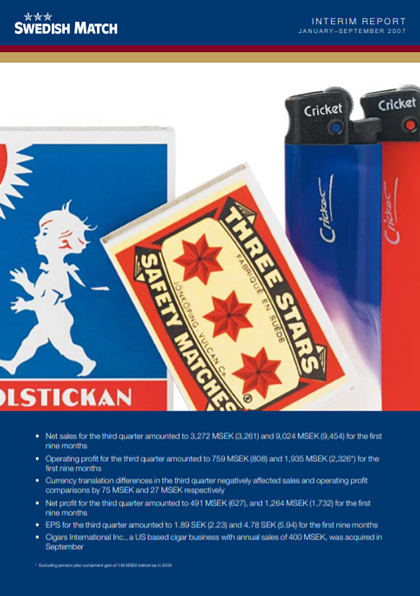
In Sweden, Swedish Match has supported the Solstickan Foundation for 75 years through its sales of certain lights products. For every product sold under the Solstickan brand, a portion of sales goes to the Solstickan Foundation. The Foundation works primarily towards the benefit of children and the elderly who are chronically ill or disabled.
In Brazil, Swedish Match continues its community involvement by supporting the “Bom Menino” (Young Boy) project, a skill building program that enables youths, ages 14 to 18, from low income families to develop educational, employment, and social skills. For more examples, see our annual report.
4. Considering the type of products you sell and the business you’re in, isn’t it contradictory that you regard social responsibility and corporate sustainability to be an important issue?
Corporate sustainability and social responsibility involve many issues and go far beyond just the products we sell. We are in the tobacco business and tobacco contains nicotine, which is addictive. However, the Company does not produce cigarettes, instead snus and snuff represent the largest part of the Company’s sales and operating profit and we believe that these kinds of smokeless products are an important element in reducing tobacco harm (harm reduction). We must behave in a responsible manner, providing customers with products consistent with our philosophy of working with societal trends, and that includes society moving away from cigarettes.
5. Do you have a ”Code of Conduct”?
Yes, Swedish Match has a Code of Conduct applicable to all Group employees, regardless of position. The Code of Conduct is the foundation for the Company’s position in areas related to corporate sustainability. The Group’s commitment to social responsibility and environmental issues is supported by its core values – innovation, recognition, growth, communication, teamwork, and trust. These core values are central to Swedish Match’s business ethics and, as such, they are demonstrated in all relations with stakeholders and are a natural part of the way we conduct business.
The Code of Conduct complies with international conventions and guidelines on human rights and labor conditions. The international conventions and guidelines referred to here are the UN’s Universal Declaration of Human Rights, the UN Convention on the Rights of the Child, the central International Labor Organization conventions (ILO), and the OECD’s Guidelines for Multinational Enterprises.
The Code of Conduct is reviewed and updated once a year by the Senior Vice President Corporate Communications and Sustainability, Emmett Harrison.
6. Which areas do your Code of Conduct cover?
The Code consists of a number of policies related to the following areas:
Workplace practices and employees
- Workplace practices (including health and safety, recruitment, and remuneration)
- Business ethics (including corruption and fraud, gifts, loans, related party transactions, honest and ethical conduct, conflict of interest, and compliance with laws)
- Communication (including designated spokespersons, public reporting and communication, and internal reporting of critical information)
Social responsibility
- Society at large (including human rights, child labor)
- Suppliers (including supplier commitment, the Group Procurement Policy)
- Customers and marketplace (including the Company’s tobacco policy)
- Joint ventures, partnerships, and associated companies
Environment
- Guidelines and policy to ensure continuous environmental improvement and prevention/education of reducing the potential negative environmental impact resulting from the Group’s activities
You will find our policies relating to Sustainability issues at the link below: http://www.swedishmatch.com/en/Sustainability/Code-of-Conduct-and-policies/
7. How can you be sure that your employees know and adhere to your Code of Conduct?
The Code of Conduct is applicable to all employees in the organization, regardless of position. All Swedish Match companies and employees shall comply with the Code of Conduct even if it stipulates a higher standard than required by national laws or regulations.
Swedish Match has an internal process where the Code of Conduct, along with all other Group policies, is distributed to managers in the countries where we operate. Every manager has an obligation to ensure that employees are informed about the Code of Conduct as well as a responsibility to foster a culture of compliance with the Code. Also, every employee has a personal responsibility to make sure that actions taken comply with both the words and the spirit of the Code of Conduct.
To ensure an ongoing high level of business ethics within the Group, the Code of Conduct is reviewed and approved annually by the Board of Directors. Various procedures are in place for monitoring and reviewing the policies stated in the Code of Conduct. The reviews are intended to ensure that employees and other stakeholders affected by the Code of Conduct are aware of, understand, and comply with its content.
Reviews, which are conducted by the external partner AON (an international risk management company), primarily comprise an examination of the Group’s operating units. Facilities are reviewed at least once every second year according to an established schedule. The reviews include implementation of the Code of Conduct as such, with evaluations in the areas of social responsibility, workplace practices, business ethics, communication, and the environment. Topic areas include human rights, child labor, forced labor, supplier contracts, as well as health and safety matters. Based on the results, the external partner presents recommendations if needed. Possible identified areas for improvement are re-evaluated the following year.
The conclusions of the reviews are reported to the operating units’ management teams and to the Corporate Communications and Sustainability function. The operating units’ management teams have operational responsibility for ensuring compliance with the Code of Conduct. The SVP Corporate Communications and Sustainability is responsible for further development and revision of the Code of Conduct.
8. How do you make sure that your suppliers adhere to your Code of Conduct?
Swedish Match is a small purchaser of tobacco, buying less than one percent of the world’s production. The Company does not perform social audits, but all suppliers of tobacco are informed about the Code of Conduct and are requested to sign and return the contract – “Social commitment for suppliers to Swedish Match”. Although no social audits are performed by the Company, tobacco purchasers visit suppliers each year to show that social commitment is of great importance to the Group and to proactively discuss social issues, such as child labor, human rights, and other important matters.
In addition, Swedish Match buys tobacco for its production of smokefree products from a small number of suppliers (for example Alliance One and Universal Leaf), who are all major international organizations with their own regulatory frameworks and controls of social and environmental issues. These groups have strict policies with regard to human rights, child labor, and farming practices. Swedish Match also encourages its suppliers without regulatory framework and controls to establish and fulfill their own codes of conduct regulating the basic rights of their employees, occupational health and safety, the prevention of child labor, ethical business conduct and environmental issues.
9. What does Swedish Match do when it finds that its policies are not adhered to?
Should a supplier fail to comply with Swedish Match’s recommendations, Swedish Match shall strive to resolve the situation through cooperation and information or terminate the relationship.
10. Child labor on the tobacco farms still exist. What are Swedish Match’s views on child labor and what actions have been taken by the company to stop this?
Child labor is indeed a difficult issue to tackle, but one that needs to be addressed.
Swedish Match does not tolerate child labor and our view on this issue follows the UN Convention on the Rights of the Child, Article 32.1.This article defines child labor as economic exploitation of children and states that children should not perform work that is likely to be hazardous or harmful to the child’s health as well as physical, mental, spiritual, moral, or social development or interferes with the child’s education (Code of Conduct, section 7.2.1).
The Company’s own operations are not considered to have significant risk for incidents of child labor but Swedish Match continuously works with tobacco suppliers to ensure that the issue of child labor is addressed.
Furthermore, Swedish Match is represented on the Board of the ECLT Foundation, Eliminating Child Labour in Tobacco-growing, www.eclt.org. ECLT is a foundation that works together with tobacco-buying companies and professional representatives with the aim of eliminating child labor on tobacco fields. Our major tobacco suppliers are also members of ECLT and in many cases have programs of their own to help enable young people to receive education.
We believe that eliminating child labor in tobacco is an issue that is better handled in a joint effort between trade unions, the corporate sector (manufacturing industry), and the tobacco growers (ITGA, International Tobacco Growers’ Association). Most of the other larger tobacco companies are also members of the organization.
11. Does everyone at Swedish Match use tobacco products?
Just like for adults working in all companies, some of our employees choose to use snus or smoke cigarettes. The use of tobacco by adults is a personal choice.
12. How can you be sure that your products are of consistently high quality for your customers?
The safety and quality of our products is an important component for Swedish Match.
The Swedish Match philosophy of tobacco harm reduction entails that smokeless tobacco products, such as Swedish snus manufactured according to Swedish Match’s quality standards, play an important role in reducing tobacco harm. The Company continuously works to reduce or eliminate the alleged harmful components in its snus and to increase knowledge about snus products and its impact on consumers.
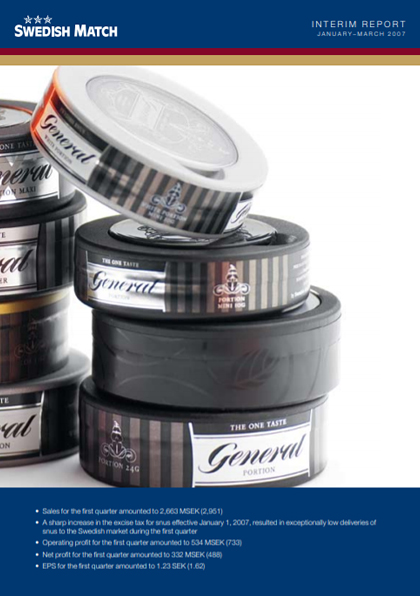
Swedish Match has developed its own quality standards, GOTHIATEK®, providing consumers with a guarantee that all of Swedish Match’s Swedish snus products undergo controls while maintaining the highest quality, from tobacco plant to the end consumer. This includes for instance requirements on maximum permitted levels of suspected elements found naturally in the tobacco plant, raw material quality requirements, manufacturing process requirements, and consumer product information requirements. GOTHIATEK® shall for consumers not only be a standard but also a symbol for trust in our ambition to always use production methods that are based on the best available knowledge regarding selection of raw materials and manufacturing practices. Today, GOTHIATEK® is adopted as an industry standard in the manufacturing process of Swedish snus. For more information, please refer to GOTHIATEK® on our website.
Most of Swedish Match’s matches are safety matches which means that the match only will be ignited when struck against a specially treated, chemically active friction surface on the side of the box. The most important properties of safety matches are that they strike easily, do not split or drop burning debris, do not easily break, do not continue to glow after the flame is extinguished, do not contain toxic heavy metals, and are environmentally friendly. Matches do not self-ignite during normal handling. Matches should be stored in dry areas and separate from ignition sources and hazardous material. The matches would not ignite when they are heated, unless the temperature exceeds 180ºC.
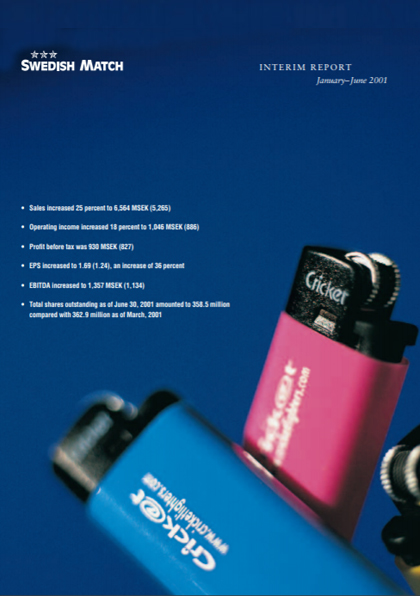
Regarding lighter safety, Swedish Match’s largest lighter brand Cricket is one of the world’s safest lighters. It is manufactured in self-extinguishing nylon, which cannot burn when the ignition source is removed. With Cricket, the “fixed flame technology” was invented to provide the best safety for consumers; a proprietary patented system where the flame is fixed and creates a uniform and reliable flame during the entire lifetime of the product. Innovative, advanced technology and quality ensure that Cricket’s child-resistant lighters comply with very high demands. All Cricket pocket lighters are manufactured according to the quality standard, ISO 9994:2006 and undergo more than 60 tests prior to being released on the market.
13. Do Swedish Match use genetically modified tobacco in your products?
No, we do not use any kind of genetically modified tobacco in our products.
14. How do you communicate the risks of using your snus products?
We do not claim that our smokeless products could not have any adverse health effects. We recognize that tobacco use raises valid questions about nicotine dependence, and the role of nicotine in special populations such as during pregnancy and among patients with cardiovascular conditions.
We believe however that adult consumers have the right to enjoy tobacco products with the common knowledge of the health risks associated with them. On our website, under the Snus and health section, we publish information about our tobacco-products. We also discuss nicotine and nicotine addiction.
15. Can you explain the concept of harm reduction in more detail?
The Swedish Match philosophy of tobacco harm reduction entails that smokeless tobacco products, such as snus manufactured according to Swedish Match’s quality standards, play an important role in reducing tobacco harm.
The health risks associated with cigarette smoking are well known and the associated costs are enormous. The harmful effects of cigarette smoking arise mainly through the burning of tobacco. Based on observations from the "Swedish experience", it has commonly been accepted among researchers that the use of snus is less harmful than smoking. The harm reduction approach is based on the recognition that the health hazards of cigarette smoking can largely be avoided by switching to smokefree sources of nicotine. There is some evidence that smokers are more likely to accept alternative tobacco products, and thus have greater success in quitting smoking, than to accept nicotine replacement products.
16. What do you think of the fact that youths use your products? Do you work together with retailers to prevent underage tobacco sales?
Swedish Match has an “Under 18 No Tobacco” policy and believes that all tobacco-products should only be sold to adults of legal tobacco age, and who are 18 years of age or over. The Company does not direct its marketing, advertising, or promotion of tobacco products to people under the age of 18.
We believe that responsible tobacco retail education and information are the most effective means of preventing the underage sale of tobacco. The Group will continue to provide support and leadership to our retail partners in any efforts they make to demonstrate their endorsement of the “Under 18 No Tobacco”-policy. We are as a Group prepared to continue partnering with retailers, distributors, and public officials throughout the world to prevent underage use of tobacco while protecting the rights of adult consumers to make an informed decision about whether they decide or decide not to use tobacco.
17. How does Swedish Match work to reduce its negative impact on the environment?
For Swedish Match, environmental sustainability implies working conscientiously and responsibly to reduce the Group’s negative environmental impacts. Although the production processes and raw materials used in the tobacco industry generally have limited environmental impact, improvements and savings from more efficient uses of resources can have positive direct benefits on the sustainability and profitability of the Group as well as cut down on the Group’s potential negative impacts on the environment. Approximately 80 percent of the raw materials used within the Group are renewable, and environmentally harmful substances are only handled to a limited extent during production.
We consider environmental issues very important and integrate our environmental work into our everyday business. This includes many things, for example introducing organic coffee in the staff canteens, replacing old energy-intensive electric equipment with new, choosing less environmentally harmful business trips or replacing them with video, telephone, or web-meetings. We furthermore work on how to deal with and reduce waste in the factories and to minimize our transports through careful logistics planning. We also strive to use environmentally friendly materials in our packaging.
We have a Group Environmental Policy with the main purpose to ensure that the Company commits itself to continuous environmental improvement with the aim of prevention/reduction of negative environmental impacts in our activities. The Group’s Environmental Council, with representation from all Swedish Match factories, is responsible for environmental issues and for reporting environmental results.
You can find more information about our environmental efforts on our website under the pages Environmental responsibility and Environmental Policy.
18. What kind of packaging does Swedish Match have for its snus and snuff cans and can you recycle them? What about other products?
We always strive to use environmentally friendly materials in our packaging, and for us sustainable product responsibility means delivering the best possible product with a minimum of waste. The Group works to minimize packaging while introducing continuous improvements that not only deliver outstanding consumer value, but also reduce the negative environmental footprint, and adhere to standards of quality. For Swedish snus, that means minimizing packaging and waste, while adhering to standards such as the GOTHIATEK® quality standards, as well as the ISO 14001 and ISO 9001 standards.
The packaging of Swedish snus is recyclable, and its content degrades naturally. For both Swedish snus and US moist snuff, the plastic cans are made from polypropylene (PP) which you can also find in ketchup bottles, yogurt containers, and tubs for margarine to give a few examples. Rolls of cans are mostly shrink-wrapped in polyethylene. At complete combustion, only carbon dioxide and water remain from these plastics. All coloring agents in the plastic are approved for food packaging or both plastic cans and plastic lids are recyclable, recycling symbol #5.
One example of a more environmentally friendly packaging is the 2011 launch of a new snus can, “Mini Star”. The new can is smaller, yet has the same amount of content as before. Compared to the previous mini can, the Mini Star can uses 21 % less plastic in manufacturing as a result of the new technology. Swedish Match is therefore able to save eight tons of plastic the first year of production. It is also a lighter weight product which takes up less space, thus reducing both packaging and transport costs. This in turn contributes to a lower environmental impact.
Another example of the Company’s environmental product/packaging improvement activities is the launch of the Eco Cricket lighter in June 2011 in certain European markets. The Eco Cricket is made with a minimum of 25 percent recycled colored nylon. It uses as little as possible of paints or inks and has no added color pigments in the body, resulting in unpredictable body color range. It has a nickel plated windshield (top cap) and no phosphate is used during the plating process (normal Cricket top cap is painted black). The Cricket logo is embossed in windshield instead of painted logo (white). Consumer packaging is minimized with less plastic and more recycled cardboard. For example, recycled cardboard is used for the trays holding the lighters. The energy consumption during the production process has also been reduced by 10 percent and no waste of nylon is generated.
Within the production of US mass market cigars, the usage of FoilFresh®, packaging has drastically reduced the number of returns from customers, which in turn has reduced waste to the landfill. Also, the use of 100 percent recycled paperboard within certain packaging formats has increased significantly. All byproduct paper from the production of packaging material used in Dothan is returned to the supplier, who then converts this to an energy source.
For matches, post consumer recycled fibers are being used for the vast majority of the production of inner and outer match boxes. Forest Stewardship Council (FSC) certified materials are increasingly being used for match cardboard.
19. Is Swedish Match certified according to any ISO-certifications?
The majority of Swedish Match’s production facilities, with products accounting for more than 95 percent of Company sales of its own produced products, are certified according to the environmental management standard ISO 14001 as well as the quality management systems standard of ISO 9001. Of twelve production facilities, ten have ISO 9001 certification and ten have ISO 14001 certification. In January 2013, Swedish Match’s lighter factory in Manaus was certified according to ISO 14001.
20. Swedish Match is a major supplier of matches. What can you say about sustainable forestry practices and biodiversity? What about FSC certification?
Swedish Match sources wood and maintains plantations for use in match production. Timber sourcing and forestry is an important area for the Group in environmental sustainability. For its production of matches, Swedish Match uses aspen, pine, and poplar, and sourcing takes place near production, primarily from sources in Sweden and Brazil. All sourcing must be from timber that meets or exceeds the minimum requirements of government regulations.
Sweden: Aspen forestry and the Forestry Stewardship Council
In Sweden, Swedish Match uses aspen wood for the manufacturing of matches. The wood is mainly sourced from the southern part of Sweden (Götaland and Svealand, excluding the northwest of Dalarna). The largest volumes are purchased through larger wood companies like “Södra” and “Mellanskog”. Lower volumes of wood are sourced directly from individual forest owners. The Company uses approximately 25,000 m3 of aspen wood per year. Aspen is growing naturally together with other kinds of wood and the cutting is often done where spruce is planted. All cutting of wood must be performed according to the Swedish forestry law and all final cutting of wood above an area of 0.5 Ha must be reported to the Swedish Forest Agency.
Swedish Match Industries AB (SMIAB, the Company’s entity which produces match products in Sweden) is since 2009 certified according to the Forestry Stewardship Council (FSC) chain of custody standard and the standard for controlled wood. Post consumer recycled fibers in the cardboard for inner and outer match boxes together with FSC certified wood can be used for the production of match boxes with FSC claims. During 2011, the production of FSC certified boxes has more than doubled compared to 2010. The supply of FSC certified wood is increasing since several big forest companies are certifying their forest. Right now, SMIAB is introducing a multi-site chain of custody system, including 10 sales companies and agents in its certificate. The main advantage of a multisite chain of custody certificate is that the sales companies and agents will be allowed to promote FSC. Read more about FSC Certification.
Brazil: meets or exceeds Brazilian regulations
In Brazil, more than 95 percent of Swedish Match’s wood consumption comes from the Company’s own plantations. The remaining small volume is bought from well reputed companies in Brazil. The wood species that are planted are pine and poplar. The Company complies with all Brazilian regulations and legislations, which are extensive and rigorous.
The Company plants close to 500 Ha’s annually, representing more than 300,000 seedlings planted every year. In the combined area of all the plantations, 20 percent of the area remains untouched for the preservation of native forest. This is in accordance with Brazilian legislation. In addition, areas adjacent to rivers are protected in accordance with the “Permanent Protection law” of Brazil.
Here are examples of environmental monitoring and control in Brazil:
- For all pest and disease controls, only materials approved by Brazilian authorities are used. Furthermore, the Company has along the years constantly thrived to replace traditional pesticides in favor of more environmentally friendly natural biological means of control.
- Birdlife as well as variety of mammals is constantly monitored. A rich variety of different species can be found on the plantations.
- Water quality in rivers inside and adjacent to plantations is monitored, upstream as well as downstream. Until now, no toxic residuals have been identified which confirms that there is no water contamination.
- In the control of weeds, the use of herbicides has been replaced by winter intercropping (Lolium multiflorum) as natural weed control.
Swedish Match Brazil is currently entering into a process of obtaining an Environmental Operational License to be issued by the State of Santa Catarina, where parts of the Company’s plantations are located. Swedish Match is one of the first companies to work towards obtaining this license. The Company expects to obtain this license, which initially will be valid for a period of four years, during 2012.
21. Does Swedish Match report on its sustainability according to any global standard?
Successful sustainability activities require a methodical approach to reporting. Therefore, Swedish Match reports its sustainability information according to the standards set forth by the Global Reporting Initiative (GRI) G3 guidelines, in order to reach measurable, transparent, clear, and comparable results.
Swedish Match currently reports according to the GRI guidelines for level C (self-declared level). Third party Application Level Check provider Tofuture Oy has confirmed Swedish Match's self-declaration that the 2011 sustainability reporting document meets GRI G3 'C' level reporting requirements.
Swedish Match also reports its carbon use under the Carbon Disclosure Project.
22. How did Swedish Match decide on which GRI measures to report?
For the past three years, the Company has sent out a sustainability survey to prioritized stakeholders, with the goal to determine which aspects of sustainability are the most important and/or have the most impact on Swedish Match today, and in the future. The input from this stakeholder dialogue is used when assessing impacts through a materiality analysis. A number of issues are selected for target and activity setting as well as reporting.
23. Is the Company listed on any Sustainability Indexes?
Yes, Swedish Match is listed on the OMX GES Sustainability Sweden Index.
24. Do you add any substances to snus, such as E500, that increases consumer addiction?
The Swedish Match quality standard, GOTHIATEK®, ensures that the contents of snus are consistent with or lower than limits prescribed by the Swedish Food Act. Sodium Carbonate (E500) is neither new to snus nor a secret ingredient. It is basically baking soda - an approved additive commonly used in food and has always been added to Swedish Match snus to ensure a stable shelf-life. Sodium Carbonate also affects the pH level in snus. The pH level in all our products has remained at the same level as long as we have produced snus. The contents of snus, including E500, have always been displayed on our cans.
There is a large body of scientific evidence about snus, not least about the complex relationships between nicotine, pH and addiction. In theory, a higher pH would increase the amount of free nicotine that can be extracted by an individual consumer. However it is an utterly unfounded allegation that we have raised the pH levels in our products. The pH levels in Swedish snus have remained at around 8.5 for as long as the product has existed. For more information about snus, nicotine, and nicotine addiction, please refer to our Snus and health section on the website.
Ultimately, as a company, we have brought and will continue to bring products to market which our consumers show a preference for and, as always, we will strive to ensure that these products are of a quality second to none. Swedish Match has gone beyond its legal obligations to voluntarily develop an open quality standard in the interest of producing the best possible products for our consumers.
25. How does Swedish Match work to reduce its environmental footprint related to the transport of its products and personnel?
Swedish Match has an ambition to develop all business in order to obtain sustainable solutions with both financial and environmental benefits. A few examples of ongoing activities are investing in appropriate video equipment to reduce the amount of travelling, encouraging employees to take the train instead of the flight when travelling, and optimizing transportation by hiring environmentally friendly transport companies when possible. The Company has also developed a Group Travel Policy available to all Swedish Match employees.
As the vast majority of production of the Company’s primary products (Snus and snuff as well as Other tobacco products) are produced and sold in the same geographic area (Scandinavia or the US/the Dominican Republic), the need for air freight or long distance transports are reduced and thus third party emissions are avoided. In addition, matches and lighters for the Brazilian market are produced in Brazil.
In 2011, a more environmentally friendly packaging for snus was launched. This was the snus can for mini white portion products. Compared with the earlier mini can, it contains about 21 percent less plastic, which leads to both a lighter weight product and the product taking up less space, thus reducing both packaging and transport costs.
26. How does Swedish Match work to promote trade union rights?
Swedish Match complies with the eight International Labour Organization (ILO) Core Conventions (Nos. 87, 98, 29, 105, 100, 111, 138, and 182). Within the area of freedom of association and collective bargaining, the Company specifically complies with convention number 87 (Freedom of Association and Protection of the Right to Organise Convention) and number 98 (Right to Organise and Collective Bargaining Convention).
According to our Code of Conduct, all employees should be free to join or form (nonviolent) assembly or associations. Employee representation structures are in place on all sites in Sweden. In accordance with the Act on Co-Determination at Work (MBL), Swedish Match has an agreement concerning collaboration with trade union organizations active in the Group´s Swedish business units. Under this agreement, a council comprising management representatives and employee representatives appointed to the board of Directors meets in advance of scheduled Board meetings and on other ad hoc occasions. The council focuses on particular issues that could result in MBL negotiations. A reference group also meets in advance of such Board meetings. The reference group comprises local trade union representatives on waged and salaried employees.
In the U.S., union rights are protected by law under the National Labor Relations Act. Swedish Match complies with all legal requirements of the Act by respecting employees’ freedom of association, mutual aid or protection, self-organization, to form, join or assist in labor organizations, to bargain collectively for wages and working conditions through representatives of their own choosing and to engage in other protected concerted activities with or without a Union.
In Brazil, union participation is mandatory according to the Brazilian Labour Laws. Annual negotiations of agreements and labor conditions are conducted within each professional category.
27. Is Swedish Match involved in any lobbying practices?
Yes. The Public Affairs team, reporting to the SVP Corporate Legal Affairs, is responsible for maintaining a dialogue with regulators, government officials, while Scientific Affairs is responsible for maintaining a dialogue with the scientific community. According to the Communications policy, individuals in these departments are authorized to speak on behalf of Swedish Match.
For the US, there are numerous registration and reporting requirements for lobbyists at the state and federal level to ensure the integrity of that practice. One example is the filing and registration requirements maintained by the Clerk of the House of Representatives and the Secretary of the United States Senate. Also, to ensure that the Company’s state lobbyists understand clearly the scope of their responsibility, including a commitment to work in favor of reducing youth usage of tobacco products, Swedish Match has contracts with them.
For the US, the individuals within the Swedish Match organization who have contact with lobbyists, as with all of the Company’s employees, are guided by the Business Conduct Policy, which mandates that all employees conduct themselves in a certain fashion in dealing with the Company’s lobbyists and giving instructions to them. For the US state program, the Company spends around 1.5 MUSD in lobbyists’ retainers and an additional 200,000 USD in support of various state organizations who believe in a free market place for adult tobacco sales. Examples would include groups such as the Ohio Grocers Association, the New York Association of Convenience Stores, etc. For the federal program, Swedish Match pays a retainer of 100,000 USD per year to The Alpine Group and has no other corporate expenses.
In Europe, the Commission and the Parliament in Brussels have a voluntary lobbying register, which the European Smokeless Tobacco Council (ESTOC) and Swedish Match have signed. Swedish Match works through ESTOC in Brussels. In addition, the Company works with Kreab (in Norway, Sweden, Denmark and Brussels). The general rule and agreement is that Kreab does not lobby on Swedish Match’s behalf. Kreab is an advisor and a speaking partner to the Company. In addition, Kreab monitors developments and regulatory processes for the Company. In Europe, Swedish Match does keep Kreab on a small retainer, mostly for advisory services.